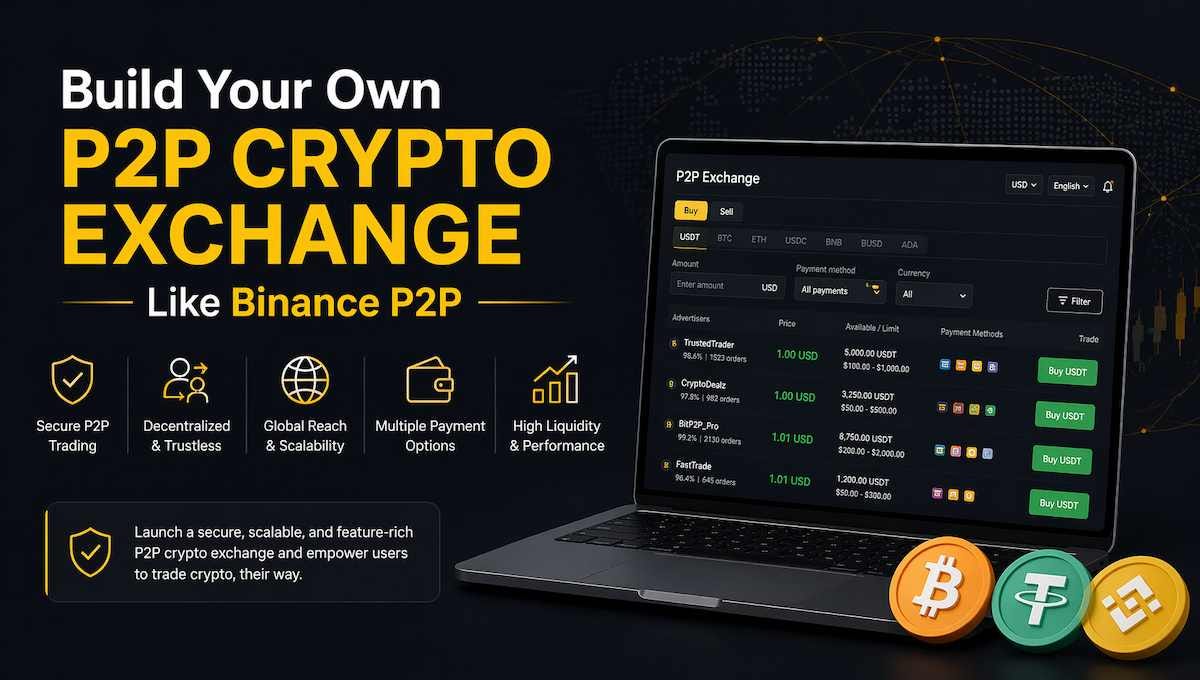
Build Your Own P2P Crypto Exchange Like Binance P2P
 James Bennett18 min read·Just now
--
Crypto trading has shifted from centralized control to direct user transactions. Earlier exchanges held user funds and matched trades internally. That model still runs, but users now prefer direct ownership and local payment options. P2P crypto exchanges meet this need by removing long-term custody from the process.
Binance P2P made this model widely known. It connects buyers and sellers directly and supports local payment methods like bank transfers, UPI, and mobile wallets. The platform locks crypto in escrow during trades and releases it after payment confirmation. This setup allows cross-border trading without forcing a single payment system.
Demand for P2P trading keeps rising in regions where banking access to crypto is limited. Asia, Africa, and Latin America show strong usage because users can trade without relying on exchange-linked bank support. This gap has created strong demand for platforms that support local currencies and direct settlement.
Many fintech companies now plan to build P2P crypto exchange like Binance P2P. Search interest around Binance P2P clone script, peer-to-peer crypto exchange development company, and white label P2P exchange solution shows active business demand for this model.
Table of content
∘ Understanding Binance P2P-Style Exchange Model
∘ Why Businesses Are Building P2P Crypto Exchanges Like Binance P2P
∘ Core Features of a Binance P2P Clone Platform
∘ Architecture of a P2P Crypto Exchange Like Binance P2P
∘ Step-by-Step Process to Build a P2P Crypto Exchange Like Binance P2P
∘ Technology Stack for P2P Crypto Exchange Development
∘ Cost to Build a P2P Crypto Exchange Like Binance P2P
∘ Security, Compliance & Legal Considerations
∘ KYC/AML Integration Requirements
∘ Monetization Strategies for a P2P Crypto Exchange
∘ Conclusion
Understanding Binance P2P-Style Exchange Model
A P2P crypto exchange connects buyers and sellers directly without holding funds for long periods. The platform supports trade creation, escrow, and dispute handling while users control their assets.
In this system, one user lists crypto for sale and another user buys it. Crypto is locked in escrow during the trade. Fiat payment happens directly between users using selected payment methods. After payment confirmation, escrow releases the crypto.
Binance P2P follows a simple flow. A seller posts an offer. A buyer selects it and starts a trade. Crypto moves into escrow. Buyer sends payment. Seller confirms receipt. Crypto is released.
This model differs from centralized exchanges, which hold user funds and match orders internally. P2P platforms depend on user-generated liquidity. Fees are usually lower and often tied to completed trades or merchant services.
Risk handling also differs. Centralized exchanges carry custody risk. P2P platforms reduce this since escrow only holds funds during active trades. This is why many businesses now prefer to build P2P crypto exchange like Binance P2P before expanding into full trading systems.
Why Businesses Are Building P2P Crypto Exchanges Like Binance P2P
Crypto trading demand now sits far beyond speculation. Many users want direct access to buy and sell crypto using local money. Traditional exchanges often stop short here. They rely on bank rails that do not cover every region. This gap has pushed attention toward peer-to-peer exchange models.
Binance P2P showed how large this demand can grow. It lets users trade crypto directly using bank transfers, mobile wallets, and cash-based methods in some regions. No central custody of fiat happens inside the platform. That structure has attracted users in countries where banking access is limited or restricted for crypto transactions.
Massive Market Demand for Fiat On-Ramps
In many developing economies, users do not rely on credit cards or global payment gateways. They depend on local payment systems such as UPI in India, bank transfers in Nigeria, mobile money in parts of Africa, and regional e-wallets across Southeast Asia.
Crypto access in these regions depends on direct fiat entry points. P2P exchanges fill that gap by allowing users to trade crypto using local currency without needing international banking access. A trader in India can buy USDT using UPI. A user in Kenya can use M-Pesa. These options remove friction that traditional exchanges cannot solve easily.
Adoption numbers reflect this demand. Chainalysis reports that emerging markets contribute a large share of global peer-to-peer crypto activity. India, Vietnam, and Nigeria remain active regions for such trading patterns. This creates a consistent user base for platforms that support local payment diversity.
Revenue Potential for Platform Owners
P2P exchange platforms do not rely on trading spreads like centralized exchanges. Revenue comes from multiple small streams that grow with transaction volume.
- Transaction fees on completed trades
- Subscription plans for verified merchants
- Paid promotion for trade listings
- Identity verification fees for higher trust tiers
Transaction fees form the most stable income source. Even a small percentage per trade becomes large when daily volume increases. Merchant subscriptions add recurring income. Verified traders often pay for better visibility and faster matching with buyers.
Featured listings also generate income. Sellers pay to place their ads at higher positions. This increases trade speed and improves liquidity flow inside the platform.
Premium identity checks add another layer. Some platforms charge for faster KYC review or higher trading limits. This model works well in regions where traders want quick onboarding.
Competitive Advantages for Startups & Fintechs
Launching a full crypto exchange requires liquidity pools, market makers, and complex trading engines. A P2P exchange removes that requirement. Liquidity comes from users themselves. Buyers and sellers create the market activity.
This reduces entry barriers for startups. A fintech company can enter a local market without building deep institutional trading infrastructure. The platform grows with user participation.
Regulatory positioning also becomes simpler in some regions. Since the platform does not hold fiat funds directly, it can avoid certain custody-related requirements. Each jurisdiction differs, but the non-custodial model often reduces licensing pressure compared to centralized exchanges.
Time to launch also becomes shorter. A basic P2P system can go live faster than a full spot or derivatives exchange. This helps businesses test demand in new markets without heavy upfront commitments.
Core Features of a Binance P2P Clone Platform
A P2P crypto exchange depends on trust, speed, and smooth trade flow. Every feature in the system supports those three factors. Binance P2P set a pattern that most new platforms follow, but each business adapts it to local markets and user habits.
User Trading Features
The trading interface forms the front layer of the platform. Users create buy or sell ads based on price, payment method, and crypto type. These listings appear in a marketplace-style layout where others can respond instantly.
A smart order matching system connects buyers and sellers based on price range, payment option, and response time. This reduces manual searching and improves trade speed.
Real-time chat sits inside every trade. Buyers and sellers confirm payment details, share transaction references, and resolve minor issues without leaving the platform. This reduces disputes and external communication risks.
Language and currency support plays a large role in adoption. A platform targeting Southeast Asia or Africa cannot rely on English-only interfaces. Local language support and fiat display options improve user participation and reduce confusion during trades.
Escrow & Security System
Escrow sits at the center of every P2P exchange. When a trade starts, the crypto amount locks inside a controlled wallet system. The seller cannot access it during the trade.
Once the buyer completes fiat payment, the seller confirms receipt, and the system releases crypto from escrow. This step reduces fraud risk on both sides.
A dispute resolution module handles conflicts. If a buyer claims payment was sent but the seller does not confirm, the system pauses the trade. Admin staff review payment proof, bank records, and chat history before releasing funds.
Fraud detection systems monitor patterns such as repeated failed trades, mismatched payment references, or unusual activity bursts. These checks reduce scam attempts that often appear in open trading platforms.
Multi-signature wallet integration adds another protection layer. It requires more than one approval before funds move from escrow in sensitive cases. This structure limits single-point failure risk.
Merchant & Vendor System
Verified merchants play a major role in liquidity and trust. These are high-volume traders who provide stable buy and sell offers across different price ranges.
Verified badges mark trusted accounts. Users often prefer trading with these accounts since they carry lower risk. Merchant ranking systems push reliable traders higher in search results.
Ranking depends on trade volume, completion rate, and response speed. High-performing merchants receive better visibility, which increases their trade flow.
Some platforms also introduce incentive programs. Merchants with higher monthly volume may receive lower fees or promotional visibility. This encourages active participation and improves liquidity inside the exchange.
Admin Dashboard
The admin system controls the entire platform operation. It monitors trade activity in real time and flags suspicious behavior patterns.
Transaction monitoring tools show active trades, completed trades, and disputed cases. Admin teams can step into ongoing trades when required.
User management tools allow verification checks, account restrictions, and tier upgrades. This keeps platform activity within safe boundaries.
Commission configuration settings let the business adjust fee structures based on region, currency, or trading pair. This flexibility helps adapt pricing models to different markets.
Risk control analytics track fraud attempts, chargeback patterns, and abnormal trading cycles. These insights help reduce operational losses and maintain trust in the platform.
Architecture of a P2P Crypto Exchange Like Binance P2P
A peer-to-peer crypto exchange works on a simple idea. One user sells crypto, another buys it. The platform sits in between only to manage trust, flow, and settlement. Binance P2P follows this pattern with strict control around escrow and dispute handling. The system depends on multiple layers that must stay in sync during every trade.
Frontend Layer
The frontend handles every user action. It includes web and mobile interfaces that show buy and sell listings, prices, and payment methods. Users place orders, chat with counterparties, and track trade status from this layer.
Design matters here. Traders often make decisions within seconds. The interface must keep steps short. A user should see crypto offers, select one, and start a trade without confusion. Any delay or clutter increases drop-offs.
Mobile access carries higher traffic in regions like India, Nigeria, and Brazil. Many users rely only on phones for trading. That makes mobile-first design a requirement, not an option.
Backend System
The backend handles trade logic and data flow. It processes requests that come from the frontend and keeps trades consistent.
The order matching engine plays a central role. It pairs buyers with sellers based on price, payment method, and region filters. Once a match happens, the system moves crypto into escrow.
The escrow transaction processor locks funds until both parties complete their part of the deal. It holds crypto securely while fiat payment happens outside the platform.
Messaging and notifications run in parallel. Traders need updates on payment status, confirmations, and disputes. Without fast updates, trust breaks down during active trades.
Wallet & Blockchain Integration
Wallet architecture decides how funds move inside the system. Most P2P exchanges use a hot wallet for active trades. This wallet holds crypto temporarily during escrow.
Cold wallets store larger reserves. These stay offline or in restricted environments to reduce exposure.
Every transaction inside escrow links back to blockchain verification. Once a trade completes, the system records the transfer on-chain. This creates a traceable record that users and admins can verify later.
Security Infrastructure
Security sits across every layer of a P2P exchange. Fraud attempts often target payment confirmation gaps between fiat and crypto settlement.
Anti-fraud systems track patterns such as repeated disputes, unusual trade timing, and repeated payment reversals. These signals help flag risky users.
DDoS protection keeps the platform available during traffic spikes or attacks. Without it, traders lose access during active trades, which creates financial disputes.
Two-factor authentication protects accounts from unauthorized access. KYC checks verify identity before users can trade large amounts. This reduces fake accounts and payment scams that often appear in peer-to-peer systems.
Step-by-Step Process to Build a P2P Crypto Exchange Like Binance P2P
Building a P2P crypto exchange follows a sequence that starts with planning and ends with live trading activity. Each stage connects directly to user trust and platform stability.
Step 1 — Business Planning & Market Strategy
The first decision involves selecting the target market. Regions such as Southeast Asia, Africa, and Latin America show high demand for crypto-to-fiat access. Many users in these areas lack access to traditional banking systems that support crypto exchanges.
Competitor study helps define positioning. Binance P2P dominates global traffic, while Paxful and OKX P2P serve specific user segments. Each platform differs in payment coverage, fee structure, and merchant incentives.
A business model must also define revenue flow early. Transaction fees, merchant listings, and premium visibility often form the main income sources.
Step 2 — Choose Development Model
Three common paths exist for building the platform.
Custom development gives full control over features, architecture, and branding. It suits long-term projects with larger budgets.
White-label P2P exchange scripts reduce setup time. These come with pre-built escrow systems, trading interfaces, and admin panels. Businesses adjust branding and launch faster.
SaaS-based deployment works for small teams testing market demand. The platform runs on shared infrastructure with limited customization.
Each option affects cost, time, and long-term control over features.
Step 3 — UI/UX Design for High Conversion Trading
User interface design directly impacts trading volume. A P2P exchange must reduce friction between intent and action.
Buy and sell flows stay short. A user selects a crypto asset, views available offers, and starts a trade in a few steps. Too many screens reduce completion rates.
Trust signals matter. Verified badges, trade history, and success rates help users decide who to trade with. Without these signals, users hesitate during transactions.
Payment method clarity also affects conversions. Users prefer platforms that show familiar local options such as bank transfers, mobile wallets, or instant payment systems.
Step 4 — Core Development
Core development focuses on the trading engine and escrow logic.
The escrow system locks crypto when a trade begins. It releases funds only after payment confirmation from both parties. This removes direct custody risk between users.
The trade engine handles matching logic. It filters offers based on price, region, and payment method. It also manages trade status updates in real time.
Payment gateway integration connects fiat systems to the platform. It does not process payments directly but verifies external transfers through user confirmation or API checks where available.
Step 5 — Security Testing & Compliance Setup
Security testing begins before launch. Any weakness in escrow or wallet logic can lead to financial loss.
If smart contracts handle escrow, audits review the code for logic errors, permission flaws, and edge cases. Even small mistakes can freeze funds or release them incorrectly.
AML and KYC systems run tests to check identity verification flows. This includes document validation, user screening, and transaction monitoring rules.
Compliance setup depends on region. Some countries require licensing for fiat-related crypto activity. Others focus only on reporting and identity verification rules.
Step 6 — Deployment & Launch Strategy
Deployment starts with infrastructure setup. Cloud servers host the frontend, backend, and database systems. Load balancing distributes traffic during peak trading hours.
Liquidity onboarding comes next. A P2P platform needs active buyers and sellers at launch. Without liquidity, users see empty markets and leave early. Merchant programs help solve this by onboarding verified traders before public release.
A beta launch often runs with limited users. Merchants test trade flows, payment confirmations, and dispute handling. Feedback from this phase shapes final adjustments before full public access.
Once stable, the platform opens to wider users. Early activity focuses on building trust, consistent trade flow, and merchant participation across multiple regions.
Technology Stack for P2P Crypto Exchange Development
A peer-to-peer crypto exchange like Binance P2P depends on fast interaction between buyers, sellers, and escrow systems. The technology stack must support real-time trading, secure fund handling, and stable performance under heavy traffic.
Each layer of the system plays a different role. Frontend handles user actions. Backend processes trades and payments. Blockchain handles escrow logic. Infrastructure holds everything together.
Frontend Technologies
The frontend carries all user interaction. Traders place ads, respond to offers, and track payments from this layer.
Most platforms use React.js or Vue.js for web interfaces. React.js works well for frequent updates on trading screens. Vue.js fits simpler interfaces with lighter development effort.
For mobile access, React Native and Flutter are widely used. React Native allows shared code across Android and iOS. Flutter provides smooth UI rendering and consistent design across devices.
P2P trading platforms rely on fast updates. Price changes, trade status, and chat messages must appear without delay. Frontend frameworks handle these updates through WebSockets or long polling methods.
A trading interface usually includes:
- Buy and sell listings
- Chat between users
- Payment status tracker
- Dispute button and trade history
These elements sit on one screen to reduce confusion during trade execution.
Backend Technologies
The backend manages trade logic, user activity, and escrow operations. It processes thousands of requests at the same time during peak trading hours.
Node.js is widely used for real-time systems. It handles concurrent connections without slowing down. Go is preferred where low latency and high throughput matter. Python often supports internal tools such as fraud detection scripts or reporting systems.
Most P2P exchanges follow a microservices structure. Each service handles a separate function:
- User service manages accounts and KYC
- Trade service processes orders
- Wallet service handles escrow funds
- Notification service sends alerts
This separation reduces failure impact. If one service slows down, others continue working.
Message brokers like RabbitMQ or Kafka handle communication between services. They pass trade updates and payment confirmations across the system.
Blockchain & Wallet Stack
Escrow sits at the center of a P2P exchange. Blockchain networks secure this process.
Ethereum, Binance Smart Chain, and Tron are commonly used for token movement. Each network supports smart contracts that lock funds during trades.
A typical escrow contract works in three steps:
- Buyer initiates order
- Crypto gets locked in smart contract
- Seller receives payment confirmation and funds release
Smart contracts remove manual control over funds during trades. This reduces disputes related to trust.
Wallet systems handle hot and cold storage. Hot wallets support live trades. Cold wallets store backup funds with limited exposure.
Most platforms connect multiple blockchain networks to support different tokens and regional preferences.
Database & Infrastructure
Data systems store user records, trades, chats, and payment logs.
PostgreSQL handles structured data such as transactions and user accounts. MongoDB stores flexible data like chat messages and trade logs.
High traffic requires horizontal scaling. Databases often run in clusters with replication for backup and recovery.
Cloud platforms like AWS, Google Cloud, and Azure host the entire system. These platforms provide:
- Load balancing for traffic spikes
- Automated backups
- Server scaling based on usage
Storage and compute resources are separated. This setup helps maintain stable performance during peak trading hours such as market volatility events.
Cost to Build a P2P Crypto Exchange Like Binance P2P
Building a peer-to-peer crypto exchange requires planning across development, security, infrastructure, and compliance. Costs vary widely depending on feature depth and launch scale.
A basic version targets early users and merchants. A full platform handles large trading volumes, multiple currencies, and complex fraud control systems.
Key Cost Factors
Several elements affect total development cost.
Feature complexity plays a major role. A simple trade system costs less than a platform with multi-language support, merchant ranking, and dispute handling.
Security infrastructure increases cost. Escrow systems, fraud detection tools, and wallet protection require additional engineering effort and audits.
Development model also affects budget. Custom development requires full design and coding from scratch. White-label solutions reduce time but limit flexibility.
Compliance adds ongoing costs. KYC verification systems, AML monitoring tools, and legal setup vary across countries. Markets like India, Europe, and the United States follow different rules for fiat transactions.
Estimated Cost Breakdown
A minimum viable product usually falls between $25,000 and $60,000. This version includes:
- Basic trading system
- Simple escrow flow
- User registration and KYC
- Limited payment methods
This stage targets early merchant onboarding and product testing.
An advanced platform ranges from $80,000 to $150,000 or higher. This includes:
- Multi-currency trading
- Advanced escrow contracts
- Fraud monitoring tools
- Merchant ranking system
- Mobile apps for iOS and Android
- Multi-region payment integration
Large exchanges with enterprise-level traffic often exceed this range due to extended security reviews and infrastructure load.
ROI Potential
P2P exchanges generate revenue through transaction fees, merchant programs, and premium listings. Even small fee percentages create steady income when trading volume grows.
Markets in Africa, Southeast Asia, and South America show strong demand for fiat-to-crypto access. These regions rely heavily on local payment methods, which P2P systems support well.
A typical growth pattern starts with merchant onboarding. Early users provide liquidity. As trade volume increases, the platform earns consistent fee income from each transaction.
Beta launch usually begins with a limited set of merchants. This stage tests escrow flow, payment confirmation speed, and dispute handling. Once stable, platforms expand into new regions and add more trading pairs.
Revenue potential depends on user trust, payment coverage, and trade frequency. Platforms that maintain stable operations during high traffic periods tend to retain merchants for longer cycles.
Security, Compliance & Legal Considerations
A P2P crypto exchange handles money movement between strangers. That creates pressure on trust, identity checks, and legal boundaries. Binance P2P and similar platforms operate in multiple regions, so they rely on strict verification systems and constant monitoring of activity.
Security in this model is not a single feature. It runs across user onboarding, trade execution, dispute handling, and fund release. Legal rules also differ across countries, which adds complexity for any platform that operates internationally.
KYC/AML Integration Requirements
User verification sits at the entry point of any serious P2P platform. It starts with identity checks and continues through transaction tracking.
User verification systems usually collect:
- Government ID such as passport or national ID
- Selfie or live video verification
- Address proof in higher-risk regions
These steps reduce fake accounts and reduce exposure to fraud networks that try to move funds through multiple identities.
Transaction monitoring tools track user behavior after registration. They flag unusual patterns such as:
- Rapid repeat trades within short time windows
- Large value transfers from new accounts
- Repeated disputes from the same users
AML checks run in the background. They compare transactions against watchlists and known risk sources. Many platforms also assign risk scores to each user based on trade history and account age.
This system does not stop every issue. It filters high-risk activity before it reaches escrow disputes.
Regional Regulatory Challenges
P2P crypto exchanges operate across borders, and each region sets different rules for digital assets.
Crypto restrictions vary widely:
- Some countries allow trading but restrict fiat conversion
- Some require registration as a financial service provider
- Some limit peer-to-peer fiat settlement channels
Licensing for fiat transactions creates another layer. Once fiat enters the system, regulators often treat the platform as a financial intermediary. That triggers reporting rules, audit requirements, and local entity registration.
For example, in some jurisdictions, platforms must:
- Register as money service businesses
- Maintain transaction records for several years
- Report suspicious activity to authorities
Operating without awareness of these rules often leads to blocked payment channels or frozen banking access.
Platforms that plan multi-country operations usually separate services by region. Each region follows its own compliance structure instead of using one global setup.
Risk Mitigation Strategy
P2P trading depends on trust between users. Since the platform does not hold direct control over fiat payments, risk control sits in escrow design and system monitoring.
Escrow protection system locks crypto assets during trade. The seller cannot access funds until the buyer confirms payment. If disputes occur, moderators step in with proof-based review.
This reduces cases where one party disappears after receiving payment.
Fraud prevention algorithms track user actions in real time. They look for patterns such as:
- Repeated cancellation of trades after payment initiation
- Mismatched payment details across accounts
- Rapid account creation from similar IP ranges
The system flags these events for manual review or temporary restrictions.
Legal structuring of platform operations also plays a role. Many platforms separate entities for:
- Technology operations
- Payment processing
- Regional compliance handling
This separation reduces exposure to single-jurisdiction risks and helps maintain banking relationships in multiple countries.
Monetization Strategies for a P2P Crypto Exchange
Revenue in a P2P crypto exchange does not depend on holding funds. It depends on transaction flow, user activity, and merchant participation. Platforms like Binance P2P earn from repeated trading activity rather than single high-value fees.
A well-structured monetization model balances affordability for users and steady income for the platform.
Transaction Fee Model
The most direct revenue source comes from trade completion fees. Each successful buy or sell order carries a small percentage charge.
Fee per trade completion usually stays low to encourage high trading volume. Even a small fee becomes meaningful when thousands of trades happen daily.
Some platforms charge:
- Buyers in certain regions
- Sellers in competitive markets
- Both sides depending on liquidity conditions
Fee structures often adjust based on trade volume tiers. Higher-volume traders may receive lower fees, which keeps large merchants active on the platform.
Merchant Subscription Plans
Merchant systems play a major role in liquidity. Verified merchants post large buy and sell orders, which stabilize trading activity.
Premium verification and visibility plans allow merchants to:
- Display ads at higher ranking positions
- Access higher trade limits
- Receive verified badges that increase trust
These subscription plans create steady monthly income for the platform. Merchants pay for visibility since better placement directly increases trade execution speed.
Some platforms also include tiered merchant levels based on:
- Monthly trading volume
- Dispute ratio
- Response time during trades
Advertising & Listing Fees
Featured ads for traders create another income channel. Users or businesses pay to highlight their buy or sell offers.
Listing fees apply when:
- Traders want priority placement in search results
- Businesses want targeted exposure in specific regions
- High-volume merchants promote stablecoin liquidity offers
This model works well in regions with high trader density. It creates competition for visibility, which increases platform earnings without affecting core trade mechanics.
API & Institutional Services
Larger exchanges extend services beyond retail users. API access allows external systems to connect directly with trading infrastructure.
Liquidity providers and fintech companies use APIs for:
- Automated trade execution
- Bulk order management
- Payment gateway integration with crypto settlement
Some platforms also offer institutional dashboards for:
- High-volume traders
- Payment processors
- OTC desks
These services create long-term contracts and predictable revenue streams. They also bring consistent liquidity into the exchange, which strengthens trade depth across markets.
Conclusion
P2P crypto exchanges let users trade directly without centralized custody, using escrow to hold crypto until fiat payment is confirmed. Binance P2P popularized this model by supporting local payment methods like bank transfers and mobile wallets, which improved access in regions with limited banking support for crypto. For businesses, this creates an entry point into crypto trading without building full exchange infrastructure since users provide liquidity through buy and sell offers. Revenue comes from trade fees, merchant subscriptions, and listing promotions. Security relies on KYC, AML checks, fraud monitoring, and escrow protection. Demand continues to grow in Asia, Africa, and Latin America, where local payment access drives most crypto activity.