Blockchain Kya Hota Hai? Bilkul Zero Se Samjho!
 Hacker MD14 min read·Just now
--
Series: Web3 Security Zero se Advance | Article #1
By HackerMD | 18 min read
Aaj Kya Seekhenge?
- Blockchain kya hota hai real life example se
- Web2 vs Web3 fark kya hai?
- Block kya hota hai andar kya hota hai?
- Chain kaise banti hai?
- Decentralization kya hota hai?
- Consensus mechanisms network agree kaise karta hai?
- Hash kya hota hai security kaise kaam karti hai?
- Blockchain ke types Public, Private, Hybrid
- Real world use cases
- Web3 Security mein kyu zaroori hai yeh sab samajhna?
Note: Yeh series Web3 Security ke liye hai isliye har concept ko hacker ki nazar se samjhenge! Jo samjha woh attack kar sakta hai jo attack kar sakta hai woh defend aur bug bounty bhi kar sakta hai!
Pehle Ek Story Sab Clear Ho Jaayega!
Socho tumhare mohalle mein ek dukaan hai
Ramesh Ki Dukaan
   Ek register hai — jisme sab kuch likha hai:
   → Kisne kitne paise diye
   → Kisne kitna udhaara liya
   → Kab diya, kab liya

Problem:
   → Register sirf Ramesh ke paas hai
   → Ramesh galat likh sakta hai
   → Register jal sakta hai, kho sakta hai
   → Ramesh cheat kar sakta hai — koi rok nahi!

Yeh hai Web2 / Traditional System:
   CENTRALIZED — ek jagah, ek insaan ka control
Ab socho yeh register ki 1000 copies ho jaayein
 Register Copy #1   → Ramesh ke paas
 Register Copy #2   → Suresh ke paas
 Register Copy #3   → Mahesh ke paas
 Register Copy #4   → Ganesh ke paas
... aur 996 aur copies duniya bhar mein ...

Ab agar Ramesh apni copy mein fraud kare:
   → Baaki 999 copies se compare hoga
   → 999 copies bolegi — "Yeh GALAT hai!"
   → Ramesh ki fraud copy REJECT ho jaayegi!
   → Koi ek akela insaan system ko corrupt
     NAHI kar sakta!

Yeh hai BLOCKCHAIN!
PART 1: Blockchain Exact Definition
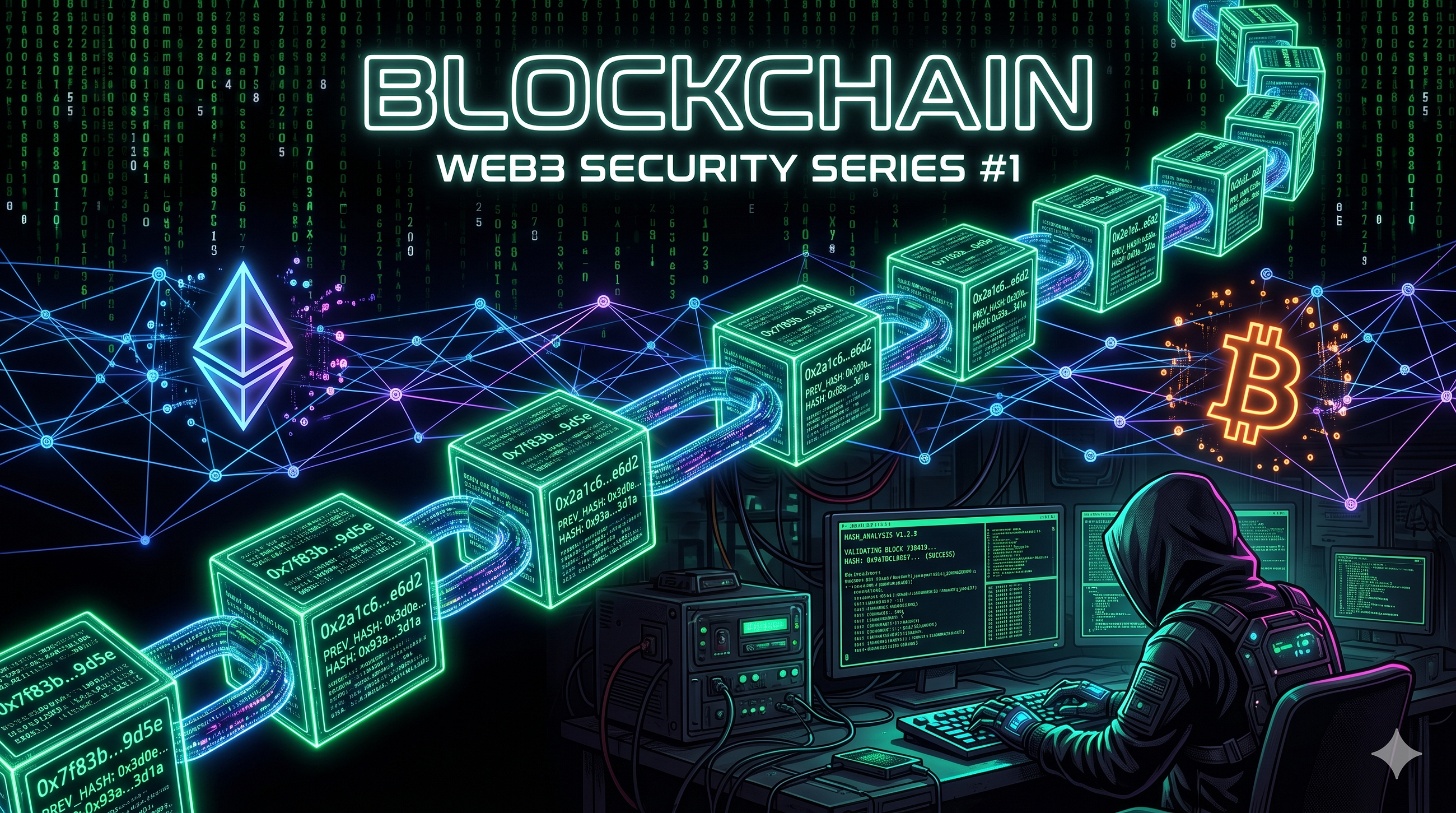
Blockchain = Block + Chain

Block  = Data ka ek packet (register ka ek page)
Chain  = Sare blocks ek dusre se linked hain

Simple definition:
"Ek distributed digital register jo
 hazaaron computers pe exist karta hai,
 jisme data secure, transparent aur
 tamper-proof tarike se store hota hai"

Technical definition:
"A decentralized, immutable ledger of
 transactions maintained across a
 peer-to-peer network using cryptography"
PART 2: Block Kya Hota Hai? Andar Kya Hai?
Ek block ek dabba ki tarah hai usme yeh hota hai:
┌─────────────────────────────────────┐
│           BLOCK #4721               │
├─────────────────────────────────────┤
│ Block Number   : 4721               │
│ Timestamp      : 2024-01-15 14:23   │
│ Nonce          : 83729              │
│                                     │
│ Previous Hash  :                    │
│ 0x1a2b3c4d5e6f...                   │
│ ← Pichle block ka "fingerprint"     │
│                                     │
│ Current Hash   :                    │
│ 0x9z8y7x6w5v4u...                   │
│ ← Is block ka "fingerprint"         │
│                                     │
│ Transactions   :                    │
│  → Alice → Bob   : 0.5 ETH          │
│  → Bob   → Carol : 1.2 ETH          │
│  → Carol → Dave  : 0.3 ETH          │
│  → [50+ aur transactions...]        │
│                                     │
│ Merkle Root    : 0xabc123...        │
└─────────────────────────────────────┘
Har Field Ka Matlab:
1. Block Number:
Har block ka serial number hota hai
Block #0 = Genesis Block (sabse pehla)
Block #1, #2, #3... aise badhte hain
Ethereum pe ab 19 million+ blocks hain!
2. Timestamp:
Exactly kab yeh block create hua
Unix timestamp format mein store hota hai
Tamper proof baad mein change nahi hota
3. Nonce (Number Used Once):
Yeh ek magic number hai
Miners isko trial-and-error se dhundhte hain
Proof of Work (PoW) mein critical role hai
Baad mein PoW section mein detail mein samjhenge
4. Previous Hash Sabse Important!
Yeh woh cheez hai jo CHAIN banati hai!

Block #1 ka Previous Hash = Block #0 ka Hash
Block #2 ka Previous Hash = Block #1 ka Hash
Block #3 ka Previous Hash = Block #2 ka Hash

Agar koi Block #2 mein koi cheez change kare:
   → Block #2 ka Hash bilkul ALAG ho jaayega
   → Block #3 ka "Previous Hash" match nahi karega!
   → Block #3 INVALID!
   → Block #4 bhi INVALID!
   → Poori aage ki chain break!

ISLIYE blockchain tamper-proof hai!
5. Current Hash:
Is block ka unique fingerprint
Block ke saare data se milke banta hai
Ek bhi byte change → Hash bilkul alag ho jaata hai!

Example:
"Hello"  → Hash: 185f8db32921bd46...
"hello"  → Hash: 2cf24dba5fb0a30e...
(sirf capital H se lowercase h — completely different!)
6. Transactions:
Is block mein recorded sabhi transactions
Bitcoin pe : Kisne kitna kisko bheja
Ethereum pe: Transactions + Smart contract calls
Ek block mein typically 100–3000 transactions
7. Merkle Root:
Sabhi transactions ka ek combined "summary hash"
Merkle Tree se banta hai (binary tree structure)
Ek bhi transaction change → Merkle Root change!
Quick verification allow karta hai
PART 3: Chain Kaise Banti Hai? Visual!
GENESIS BLOCK (Block #0)
┌──────────────────────┐
│ Block   #0           │
│ PrevHash: 0x0000000  │ ← Koi prev nahi!
│ Hash    : 0xAAA111   │
│ Txns    : [...]      │
└──────────────────────┘
          │
          │ Hash: 0xAAA111
          ↓
BLOCK #1
┌──────────────────────┐
│ Block   #1           │
│ PrevHash: 0xAAA111   │ ← Block #0 ka hash!
│ Hash    : 0xBBB222   │
│ Txns    : [...]      │
└──────────────────────┘
          │
          │ Hash: 0xBBB222
          ↓
BLOCK #2
┌──────────────────────┐
│ Block   #2           │
│ PrevHash: 0xBBB222   │ ← Block #1 ka hash!
│ Hash    : 0xCCC333   │
│ Txns    : [...]      │
└──────────────────────┘
          │
          │ Hash: 0xCCC333
          ↓
BLOCK #3 (Latest)
┌──────────────────────┐
│ Block   #3           │
│ PrevHash: 0xCCC333   │ ← Block #2 ka hash!
│ Hash    : 0xDDD444   │
│ Txns    : [...]      │
└──────────────────────┘

━━━━━━━━━━━━━━━━━━━━━━━━━━━━━━━━━━━━

Ab agar koi FRAUD karne ki koshish kare:

FRAUD ATTEMPT → Block #1 mein change:

Block #1 (Tampered)
┌──────────────────────┐
│ Block   #1           │
│ PrevHash: 0xAAA111   │
│ Hash    : 0xXXXXXX   │ ← Hash BADAL GAYA!
│ Txns    : [FRAUD!]   │
└──────────────────────┘
          │
          ↓
Block #2 — INVALID!
┌──────────────────────┐
│ Block   #2           │
│ PrevHash: 0xBBB222   │ ← 0xXXXXXX se
│                      │   match nahi hoga!
│    REJECTED by       │
│    ALL NODES!        │
└──────────────────────┘

Fraud detect ho gaya!
Network ne reject kar diya!
PART 4: Decentralization Asli Takat!
CENTRALIZED (Web2 — Aaj ka internet):

              ┌─────────┐
              │  SERVER │   ← Ek jagah sab kuch
              │ (Google,│
              │  Banks) │
              └─────────┘
             /     │     \
          User1  User2  User3

Problems:
   → Single point of failure
   → Hack ho sakta hai — sab data gone!
   → Company band ho jaaye → sab gone
   → Company tumhara data sell kar sakti hai
   → Account freeze ho sakta hai!
   → Government pressure pe data de sakti hai

━━━━━━━━━━━━━━━━━━━━━━━━━━━━━━━━━━━━

DECENTRALIZED (Web3 — Blockchain):

  Node1 ─── Node2 ─── Node3
    │   ╲  /    ╲  /    │
    │    ╲╱      ╲╱     │
  Node4 ─── Node5 ─── Node6
    │   ╲  /    ╲  /    │
  Node7 ─── Node8 ─── Node9

Har Node = Ek computer jiske paas
           POORI blockchain ki copy hai!

Ethereum pe: 7,000+ full nodes worldwide!

Ek node hack ho jaaye?
   → Koi fark nahi! 6,999 aur hain!
   → Hacker ko 51%+ nodes simultaneously
     hack karna padega
   → Practically impossible!
   → Bahut zyada expensive!
Node Ke Types:
Full Node:
   → Poori blockchain download karke rakhi hai
   → Sari transactions verify karta hai
   → Network ka backbone
   → Ethereum full node: ~1 TB storage

Light Node:
   → Sirf latest blocks store karta hai
   → Full node pe kuch checks ke liye trust
   → Mobile wallets yeh use karte hain

Validator Node (PoS):
   → New blocks propose aur validate karta hai
   → 32 ETH stake karna padta hai
   → Reward milta hai ETH mein

Miner Node (PoW):
   → Puzzles solve karke new blocks banata hai
   → BTC/ETH reward milta tha
   → Bitcoin pe aaj bhi yahi hota hai
PART 5: Hash Kya Hota Hai? Security Ki Neev!
Hash Function = Ek mathematical function jo:
   → Koi bhi size ka INPUT le sakta hai
   → FIXED SIZE output deta hai
   → Same input → HAMESHA same output
   → Alag input → BILKUL alag output
   → Output se input NIKALNA IMPOSSIBLE!
     (One-way function)

Blockchain Ethereum Keccak-256 use karta hai:

Input : "Hello"
Hash  : 185f8db32921bd46d35c94b7af8d31e4
        7bc7cef372f58dd1dbb1f90d2e7b9d98

Input : "Hello."   ← Sirf ek dot add kiya
Hash  : f9d4e24420b9570b43f1e9c6f4e5bb2f
        4b3b9e3d1c2a8f7e6d5c4b3a291e8d7c
        (BILKUL ALAG!)

Input : [Poori Harry Potter series — 500 pages]
Hash  : a1b2c3d4...  (Same 64 characters!)

Input : [Poori Wikipedia — Terabytes]
Hash  : x9y8z7w6...  (Same 64 characters!)

Blockchain mein use:
   → Block ka hash    = Block ka fingerprint
   → Transaction ID   = Transaction ka hash
   → Merkle Root      = All txns ka combined hash
   → Password storage = Hash stored, not password
Python Mein Khud Try Karo:
import hashlib
import json

def sha256_hash(text):
    return hashlib.sha256(
        text.encode()
    ).hexdigest()

# Basic demo
print(sha256_hash("Hello"))
# 185f8db32921bd46d35c94...

print(sha256_hash("Hello."))
# f9d4e24420b9570b43f1e9...
# Completely different!

# ─── Mini Blockchain Simulation ───────────

class Block:
    def __init__(self, number, data, prev_hash):
        self.number    = number
        self.data      = data
        self.prev_hash = prev_hash
        self.hash      = self.calculate_hash()

    def calculate_hash(self):
        content = json.dumps({
            "number"    : self.number,
            "data"      : self.data,
            "prev_hash" : self.prev_hash
        })
        return sha256_hash(content)

# Genesis Block
block0 = Block(0, "Genesis Block", "0" * 64)
print(f"\nBlock #0 Hash: {block0.hash[:20]}...")

# Block #1
block1 = Block(1, "Alice→Bob: 1 ETH", block0.hash)
print(f"Block #1 Hash: {block1.hash[:20]}...")

# Block #2
block2 = Block(2, "Bob→Carol: 0.5 ETH", block1.hash)
print(f"Block #2 Hash: {block2.hash[:20]}...")

# ─── Tamper Attempt ───────────────────────
print("\n--- FRAUD ATTEMPT ---")
print(f"Original Block #1 hash: {block1.hash[:20]}...")

# Attacker changes transaction data!
block1.data = "Alice→Bob: 9999 ETH"  # Fraud!
block1.hash = block1.calculate_hash()
print(f"Tampered Block #1 hash: {block1.hash[:20]}...")

# Block #2 ka prev_hash ab match nahi karega!
if block2.prev_hash != block1.hash:
    print("❌ FRAUD DETECTED!")
    print("   Block #2 prev_hash mismatch!")
    print("   Network ne REJECT kar diya!")
else:
    print("✅ Chain valid")
Output:
Block #0 Hash: 6b86b273ff34fce1...
Block #1 Hash: 3f79bb7b435b05...
Block #2 Hash: 2c624232cdd221...

--- FRAUD ATTEMPT ---
Original Block #1 hash: 3f79bb7b435b05...
Tampered  Block #1 hash: a8f5f167f44f4d...

   FRAUD DETECTED!
   Block #2 prev_hash mismatch!
   Network ne REJECT kar diya!
PART 6: Consensus Mechanism Network Agree Kaise Karta Hai?
Problem:
   1000 nodes hain — koi naya block aata hai
   Kaun decide karega valid hai ya nahi?
   Koi central authority nahi — toh?

Solution: Consensus Mechanism
   "Rules jinpe sare nodes agree karte hain"
Proof of Work (PoW) Bitcoin Wala:
Concept: Kaam karo — reward pao!

Process:
   1. Pending transactions mempool mein aate hain
   2. Miners compete karte hain
   3. Competition: Ek mathematical puzzle solve karo
   4. Puzzle: Ek "Nonce" dhundho taaki block ka hash
              "00000..." se shuru ho
   5. Sirf trial-and-error se possible hai
   6. Pehla miner jo solve kare → block add karta hai
   7. Reward milta hai: Currently 3.125 BTC (~$200K!)

Visual:
   Nonce = 0    : Hash = "a7f3bc9e..."
   Nonce = 1    : Hash = "9d2e1f4a..."
   Nonce = 2    : Hash = "3k8m2n7p..."
   Nonce = 83729: Hash = "00000a1b..." FOUND!

Kyun secure hai?
   → Valid block banane mein enormous energy lagti hai
   → Fraud ke liye honest mining se zyada kaam
   → 51% attack = Duniya ki 50% computing power
   → Bitcoin 51% attack cost: $20 Billion+/hour!

Problem:
   → Bahut zyada electricity consume karta hai
   → Bitcoin = Portugal jaisi country ka energy!
Proof of Stake (PoS) Ethereum Wala (2022 se):
Concept: Stake karo — validator bano!

Process:
   1. 32 ETH "stake" karo (lock kar do)
   2. Validator ban jaao
   3. Network randomly tumhe block propose karne deta
   4. Propose karo → check hoga → reward milega (~5% APY)
   5. Fraud karo → tumhari stake "SLASHED" ho jaayegi!
      (Burn ho jaayegi — permanently!)

Example:
   32 ETH stake = ~$100,000 (current price pe)
   Fraud kiya   → 32 ETH gone = $100,000 instantly!
   Isliye fraud nahi karte!

Kyun better than PoW?
   → 99.95% less energy!
   → More validators possible
   → Ethereum ne "The Merge" (Sep 2022) mein switch kiya
   → Environment friendly
PoW vs PoS Comparison:
Feature             | PoW (Bitcoin)   | PoS (Ethereum)
--------------------|-----------------|----------------
Energy Use          | Very High       | Very Low
Security            | Very High       | High
Decentralization    | High            | High
Who creates blocks? | Miners          | Stakers
Entry requirement   | Mining rigs     | 32 ETH
Block time          | ~10 minutes     | ~12 seconds
Eco-friendly?       | No              | Yes
Reward              | 3.125 BTC/block | ~5% APY
PART 7: Blockchain Types Teen Types!
1. PUBLIC BLOCKCHAIN
   → Koi bhi join kar sakta hai
   → Koi bhi transactions dekh sakta hai
   → Fully decentralized
   → Examples: Bitcoin, Ethereum, Solana, Polygon
   → Use case: Crypto, DeFi, NFTs, Smart Contracts
   → Security: Highest (maximum nodes)

2. PRIVATE BLOCKCHAIN
   → Sirf invited members join kar sakte hain
   → Ek organization control karti hai
   → Centralized internally
   → Examples: Hyperledger Fabric, Corda
   → Use case: Supply chain, Banking, Healthcare
   → Security: Depends on organization

3. CONSORTIUM / HYBRID BLOCKCHAIN
   → Multiple organizations milke control karte hain
   → Semi-decentralized
   → Examples: Quorum (JPMorgan), R3 Corda
   → Use case: Inter-bank transactions
   → Security: Medium (depends on members)

4. LAYER 2 (Bonus!)
   → Main blockchain ke upar chalta hai
   → Faster + Cheaper transactions
   → Main chain se security inherit hoti hai
   → Examples: Polygon, Arbitrum, Optimism
   → Use case: DeFi, Gaming, NFTs at low cost
PART 8: Real World Examples Kahan Use Ho Raha Hai?
1. CRYPTOCURRENCY
   Bitcoin, Ethereum, Solana...
   Peer-to-peer money transfer — no bank needed!

   Ankleshwar → New York transfer:
   Blockchain : 10 seconds, $0.10 fee
   Bank Wire  : 3-5 days, $30-50 fee
   Clear winner!

2. DeFi (Decentralized Finance)
   Loans bina bank ke
   Interest earn karo apne crypto pe
   Crypto exchange karo (Uniswap)
   Sab kuch code se — koi human nahi!

3. NFTs (Non-Fungible Tokens)
   Digital ownership proof on blockchain
   Art, Music, Games, Virtual land
   Yeh articles bhi NFT ho sakte hain!

4. Supply Chain
   Mango kahan se aaya — track karo!
   Medicine authentic hai? — verify karo!
   Walmart, Maersk, IBM use kar rahe hain

5. Voting
   Transparent tamper-proof elections
   Several countries experiment kar rahe hain
   India bhi pilot projects kar raha hai

6. Healthcare
   Medical records securely share karo
   Patient apna data control kare
   Drug authenticity verify karo

7. Gaming
   Axie Infinity, Decentraland, Gods Unchained
   In-game items truly tumhare!
   Sell karo — real money pao!
PART 9: Ek Transaction Ki Poori Journey!
Alice ne Bob ko 1 ETH bhejna hai:

┌─────────────────────────────────────┐
│ STEP 1: Transaction Create          │
│                                     │
│ Alice apni private key se sign:     │
│ {                                   │
│   "from"     : "0xAlice...",        │
│   "to"       : "0xBob...",          │
│   "value"    : 1 ETH,               │
│   "gas"      : 21000,               │
│   "gasPrice" : 20 gwei,             │
│   "nonce"    : 42,                  │
│   "signature": "0xABC_sign..."      │
│ }                                   │
└──────────────┬──────────────────────┘
               │
               ▼
┌─────────────────────────────────────┐
│ STEP 2: Network Pe Broadcast        │
│                                     │
│ Alice ka wallet → Sabhi nodes ko    │
│ Sab nodes apne "MEMPOOL" mein store │
│(Mempool = Pending txns waiting area)│
└──────────────┬──────────────────────┘
               │
               ▼
┌─────────────────────────────────────┐
│ STEP 3: Validator Pick Up           │
│                                     │
│ Ek validator mempool se txns pick   │
│ Gas fee zyada = Priority milegi!    │
│ "Jaldi chahiye? Zyada gas do!"      │
└──────────────┬──────────────────────┘
               │
               ▼
┌─────────────────────────────────────┐
│ STEP 4: Block Create                │
│                                     │
│ Multiple transactions ek block mein │
│ Hash calculate hota hai             │
│ Block network ko propose hota hai   │
└──────────────┬──────────────────────┘
               │
               ▼
┌─────────────────────────────────────┐
│ STEP 5: Network Validates           │
│                                     │
│ Doosre validators check karte hain: │
│ ✅ Alice ke paas 1 ETH tha?         │
│ ✅ Signature valid hai?             │
│ ✅ Nonce sahi hai?                  │
│ ✅ Gas sufficient hai?              │
│ ✅ Block hash valid hai?            │
└──────────────┬──────────────────────┘
               │
               ▼
┌─────────────────────────────────────┐
│ STEP 6: FINALIZED!                  │
│                                     │
│ Alice : -1 ETH (minus gas fee)      │
│ Bob   : +1 ETH                      │
│ TxID  : 0xTxHash...                 │
│ Forever on blockchain!              │
│ Time  : ~12 seconds (Ethereum)      │
└─────────────────────────────────────┘
PART 10: Security Hacker Ki Nazar Se!
Blockchain kyun secure hai?

1. CRYPTOGRAPHIC SECURITY
   → Keccak-256 hashing (Ethereum)
   → SHA-256 hashing (Bitcoin)
   → Mathematically unbreakable
   → Quantum threat future mein... (watch out!)

2. DECENTRALIZATION
   → No single point of failure
   → 7000+ nodes worldwide
   → Sab ke paas same copy

3. IMMUTABILITY
   → Past data change nahi ho sakta
   → Har node verify karta hai
   → Cryptographic proofs har block mein

4. CONSENSUS
   → Majority agree kare tabhi valid
   → 51% attack astronomically expensive

PAR... yeh sab BLOCKCHAIN ke liye sach hai!

SMART CONTRACTS alag story hai!

Smart Contract = Code on blockchain
Code mein bugs ho sakte hain!

Proof:
   → $625M    Ronin Bridge Hack (2022)
   → $320M    Wormhole Hack (2022)
   → $197M    Euler Finance Hack (2023)
   → $60M     TheDAO Hack (2016)
   → $3.8B    Total stolen in 2022 alone!

Blockchain = SECURE
Smart Contracts = CAN BE VULNERABLE

Isliye Web3 Security seekhna zaroori hai!
Isliye Immunefi pe $100M+ bounties hain!
Isliye tum yeh series padh rahe ho!
PART 11: Blockchain Ki Limitations Honest Baat!
1. SCALABILITY
   Bitcoin    :  7 transactions/second
   Ethereum   : 15-30 transactions/second
   Visa       : 24,000 transactions/second
   → Solution : Layer 2 (Polygon, Arbitrum, Optimism)

2. GAS FEES
   Peak time pe $50-200 per transaction!
   → Solution : PoS + L2 ne drastically reduce kiya

3. ENERGY (PoW mein)
   Bitcoin = Portugal jaisi country ka energy!
   → Solution : Ethereum PoS pe gaya (99.95% less!)

4. SMART CONTRACT BUGS  ← Our Main Focus!
   Code deploy hone ke baad change nahi hota!
   Bug = Billion dollar loss possible!

5. REGULATORY
   Different countries, different laws
   India: Legal but 30% tax on gains

6. UX (User Experience)
   Private key kho gayi = Sab kuch gone!
   No "Forgot Password" button!

7. ORACLE PROBLEM
   Blockchain ko real-world data chahiye
   Oracle se aata hai → Oracle hack ho sakta!
   (Series Article #28-29 mein cover karenge!)
PART 12: Key Terms Quick Glossary
Term             | Meaning
-----------------|----------------------------------------------
Blockchain       | Distributed tamper-proof ledger
Block            | Data ka packet (hash, txns, prev_hash)
Hash             | Data ka unique fingerprint
Node             | Network participant computer
Miner            | PoW mein block create karne wala
Validator        | PoS mein block create karne wala
Consensus        | Network agreement mechanism
PoW              | Proof of Work (Bitcoin style)
PoS              | Proof of Stake (Ethereum style)
Mempool          | Pending transactions waiting pool
Gas              | Ethereum mein transaction fee
Nonce            | Number used once (mining/tx)
Genesis Block    | Blockchain ka sabse pehla block
51% Attack       | Majority nodes control ka attack
Smart Contract   | Self-executing code on blockchain
dApp             | Decentralized Application
DeFi             | Decentralized Finance
NFT              | Non-Fungible Token
Wallet           | Keys manage karne wala software
Private Key      | Tumhara secret — kabhi share mat karo!
Public Key       | Tumhara address — freely share karo
Layer 2          | Main chain ke upar fast/cheap network
Slashing         | PoS mein validator ki stake burn karna
Merkle Tree      | Transactions ka tree-structured hash
PART 13: Hands-On Practice Abhi Karo!
# ─── Task 1: Live Blockchain Dekho ────────

# Browser mein jaao:
https://etherscan.io

# Latest block click karo:
→ Block number dekho
→ Transactions count dekho (100-200 usually)
→ Gas used dekho
→ Validator address dekho
→ Block hash copy karo (0x se shuru hoga)

# ─── Task 2: Ek Transaction Dekho ─────────

# Koi bhi transaction click karo:
→ From address
→ To address
→ Value (ETH amount)
→ Gas fee (kitna pay kiya)
→ Timestamp
→ Status: Success ya Failed

# ─── Task 3: Python Mein Hash Try Karo ────

python3
>>> import hashlib
>>> hashlib.sha256(b"Hello").hexdigest()
>>> hashlib.sha256(b"hello").hexdigest()
>>> # Difference dekho — ek character alag!

# ─── Task 4: MetaMask Setup ────────────────

# Install: https://metamask.io
# Sepolia Testnet add karo (free practice!)
# Free test ETH lo:
# https://sepoliafaucet.com

# ─── Task 5: Mini Blockchain Code Run Karo ─

# Upar wala Python code copy karo
# Run karo — fraud attempt ka output dekho!

# ─── Bonus Task ────────────────────────────

# USDC Smart Contract dekho on Etherscan:
# 0xA0b86991c6218b36c1d19D4a2e9Eb0cE3606eB48
# Contract → Code tab → Solidity code!
# Yeh wahi code hai jisme bugs dhundhne hain!
Quick Revision
 Blockchain   = Distributed tamper-proof ledger
 Block        = Data + PrevHash + Nonce + Hash
 Hash         = Kisi bhi data ka unique fingerprint
 Decentralized = 7000+ nodes — no single control
 Consensus    = Network kaise agree karta hai
 PoW          = Mining — puzzle solve = reward
 PoS          = Staking — 32 ETH lock = validator
 Blockchain   = Cryptography + Decentralization
 Weakness     = Smart Contract CODE mein bugs!
 Opportunity  = Bugs dhundho = Millions earn karo!
Meri Baat…
Jab maine pehli baar blockchain padha tha:
“Yeh toh sirf ek complicated database hai!”
Par phir samjha
Traditional Database (Web2):
   → Company delete kar sakti hai tumhara data
   → Bank freeze kar sakta hai account
   → Hack ho sakta hai ek baar mein

Blockchain (Web3):
   → Koi delete nahi kar sakta
   → Koi freeze nahi kar sakta
   → Hack karne ke liye $20 Billion/hour chahiye

Aur is "unhackable" blockchain pe
Smart Contracts run karte hain —
jo CODE se bane hain...

Code = Bugs possible!
Bugs = Billions lost!
Bugs dhundho = Bounty pao!

Isliye Web3 Security ek
$10 Billion/year opportunity hai!
Immunefi pe akele $100M+ bounties paid!

Tumhara journey shuru ho chuka hai! 🚀
Article #2 mein: Web2 vs Web3 Security exact attack surface, kya alag hai, kahan se shuru karo hunting!
HackerMD — Web3 Security Researcher
GitHub: BotGJ16 | Medium: @HackerMD
Next: Article #2 Web2 vs Web3: Security Perspective
#Blockchain #Web3Security #BugBounty #Hinglish #Ethereum #Bitcoin #HackerMD