Bitcoin Mixing Engine Explained: How Modern Systems Break Transaction Traceability
--
Blockchain transparency is often described as a strength. Yet for many users, it introduces a challenge that is rarely discussed in practical terms. Every Bitcoin transaction leaves a permanent record. Over time, those records can be linked, analyzed, and interpreted.
This creates a simple but important concern. How can financial activity remain private when the underlying system is public?
To answer that, it helps to understand the concept behind a bitcoin mixing engine explained in real-world terms.
The Problem: Transparency vs Privacy
Bitcoin transactions are not anonymous by default. They are pseudonymous. Addresses do not carry names, but patterns can still reveal connections.
When funds move directly between wallets:
- Transaction history remains intact
- Wallet relationships can be mapped
- Behavioral patterns emerge
For users operating across multiple transactions, this can gradually build a detailed financial footprint.
This is where the need for a crypto anonymization process becomes relevant.
How BTC Tumblers Actually Work
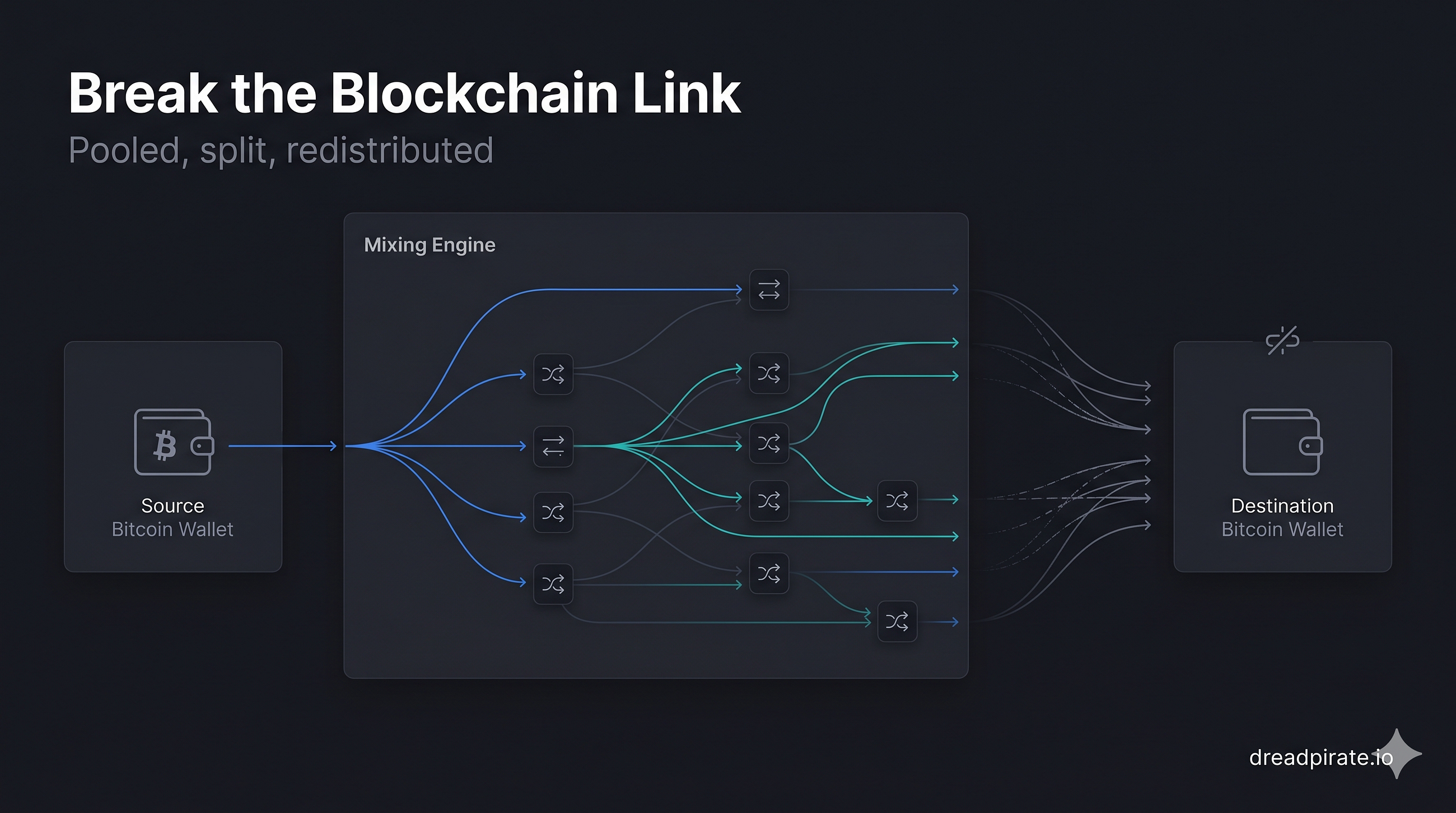
At a technical level, a mixing engine is designed to disrupt traceability. It does this by removing the direct relationship between incoming and outgoing coins.
The process can be broken down into three stages:
1. Pooling
Incoming BTC is combined with thousands of other coins. This creates a large liquidity base where individual inputs lose distinction.
2. Splitting
Funds are divided into smaller portions. This prevents simple one-to-one transaction mapping.
3. Redistribution
Outputs are sent from different sources, often across exchange-based liquidity. The coins received are not the same coins sent.
This multi-step process is the foundation of how BTC tumbler works in practice.
Breaking the Chain: What It Really Means
The phrase “breaking the chain” is often used, but it deserves clarification.
A blockchain link exists when:
- A transaction can be traced backward
- Input and output addresses are connected
- Patterns can be followed across multiple steps
A properly implemented mixing engine ensures:
- No direct transaction continuity
- Fragmented transaction paths
- Independent output sourcing
This is how systems aim to break blockchain link relationships in a meaningful way.
Example Use Case
Consider a user transferring BTC across borders.
Without mixing:
- The source wallet is visible
- Transaction origin can be traced
- Patterns may reveal financial activity
With mixing:
- Input coins are merged into a large pool
- Output coins originate from unrelated sources
- The link between sender and receiver is removed
This creates a practical layer of privacy that aligns with real-world needs.
DreadPirate’s Approach
Dread Pirate applies this concept through a proprietary mixing engine developed in-house. The system is not dependent on external APIs or shared infrastructure.
Its design includes:
- Mixing BTC with thousands of other coins
- Splitting and distributing funds across exchange sources
- Returning clean BTC with AML levels between 0–25%
- Zero-log policy ensuring all order data is deleted after completion
- PGP-signed Letters of Guarantee providing verifiable proof of each transaction
Additionally, users can choose to receive Monero (XMR) as an output by simply providing an XMR address.
Why Infrastructure Matters
Not all mixers operate the same way.
Systems relying on third-party APIs introduce:
- Shared liquidity risks
- External data exposure
- Dependency on third-party uptime
A self-contained engine removes these variables, keeping the process internal and controlled.
A Question for the Community
If Bitcoin remains transparent by design, should privacy be treated as an optional feature or a necessary layer?
This question continues to shape how users interact with blockchain systems.
Conclusion
Understanding a bitcoin mixing engine explained in practical terms helps clarify how privacy can be achieved without altering the underlying blockchain.
The process is not about hiding transactions, but about removing unnecessary traceability.
Explore DreadPirate’s privacy layer:
https://dreadpirate.io/