Biohacking Leadership: Stop Managing, Start Engineering
What Beavers, Wolves, and Sea Stars Can Teach Us About Building Better Businesses
 Udbhav Writes4 min read·Just now
--
In 2026, traditional management is breaking down.
Global employee engagement has dropped to just 20–21%, costing the world economy nearly $10 trillion in lost productivity, around 9% of global GDP. Burnout impacts nearly half the workforce. Managers themselves are disengaging. And outdated, top-down leadership styles are fueling quiet quitting, high turnover, and stalled innovation.
What if the problem isn’t execution, but the model itself?
What if leadership isn’t about managing people, but engineering environments where they thrive?
The Shift: From Managing People to Engineering Systems
Traditional management was built for the Industrial Revolution, hierarchical, control-driven, and efficiency-focused. It treated people like components in a machine.
That model no longer works.
Today’s workforce demands autonomy, purpose, psychological safety, and growth. When these are missing, performance drops, no matter how many KPIs or dashboards you introduce.
This is where biohacking leadership comes in.
Introduced in Biohacking Leadership: Leveraging the Biology of Behavior to Maximize Your Impact (2025), this approach blends neuroscience, behavioral biology, and systems thinking. Instead of forcing performance, it designs conditions where performance emerges naturally.
Think less “manager,” more “ecosystem architect.”
And for that, nature offers a powerful blueprint.
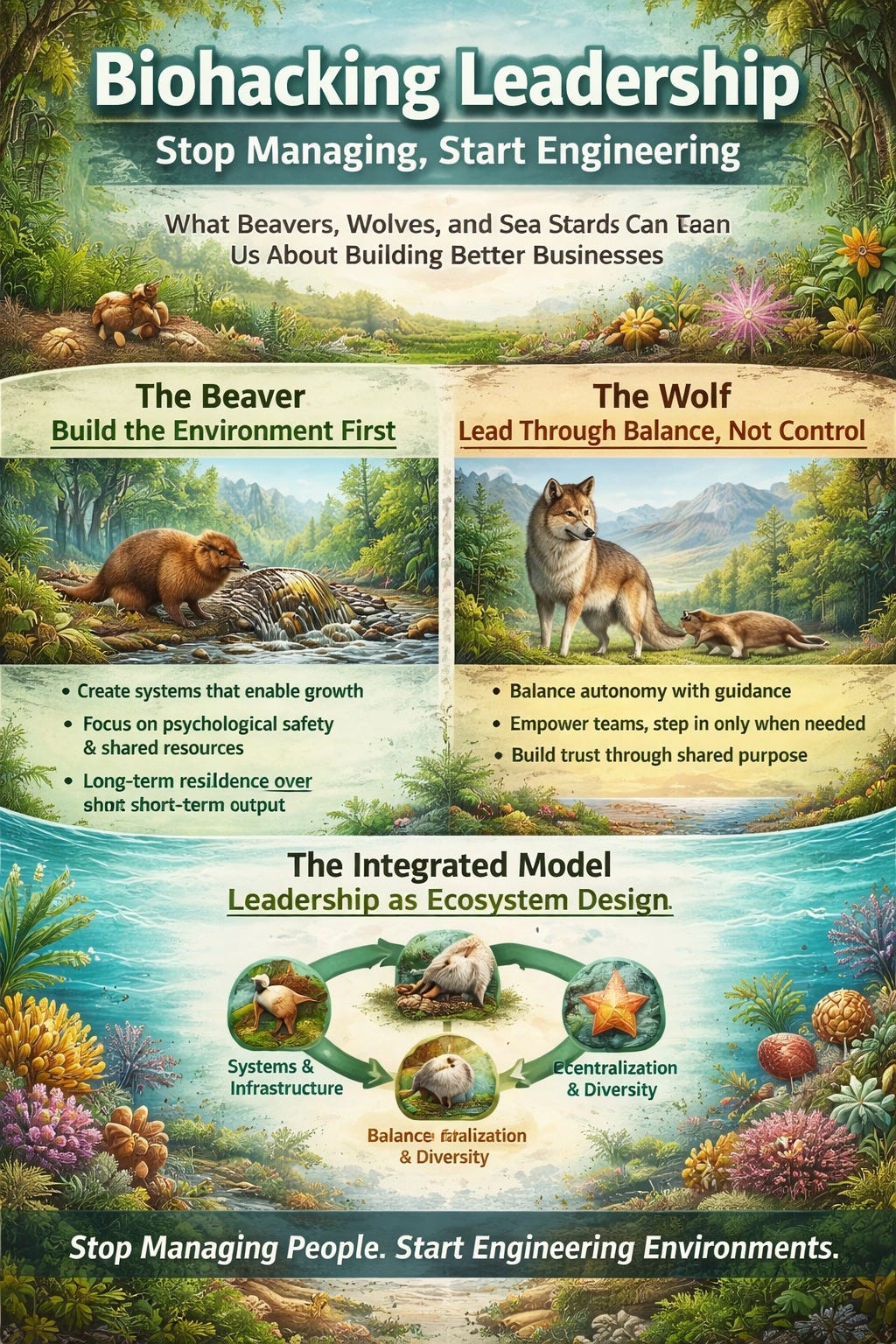
The Beaver: Build the Environment First
Beavers don’t manage ecosystems, they transform them.
By building dams, they create entire habitats that support biodiversity, regulate water systems, and increase resilience. Their impact extends far beyond their immediate needs.
Leadership takeaway:
Stop directing tasks. Start designing systems.
High-performing leaders don’t micromanage, they build environments where teams can succeed independently.
How to apply this:
- Create psychological safety as a foundation for performance
- Build shared infrastructure (tools, processes, knowledge systems)
- Focus on long-term resilience over short-term output
- Design workflows that enable autonomy, not dependency
Reflection:
Are you optimizing tasks, or engineering conditions for success?
The Wolf: Lead Through Balance, Not Control
Forget the outdated “alpha wolf” myth. Real wolf packs operate as family units, led through balance, trust, and shared purpose.
They collaborate, adapt roles dynamically, and maintain equilibrium within the group.
Leadership takeaway:
Master balance, between control and autonomy.
Great leaders know when to step in and when to step back.
How to apply this:
- Define clear roles, but allow flexibility
- Lead from behind when needed, empower your team to execute
- Intervene only when necessary (conflict, misalignment, risk)
- Build trust through shared goals, not authority
Biological insight:
Balanced environments increase trust (oxytocin) and reduce stress (cortisol), directly improving performance.
Reflection:
Are you leading every move or enabling your team to lead?
The Sea Star: Design for Resilience and Regeneration
Sea stars are decentralized. They have no central brain and yet they thrive.
If one arm is lost, it regenerates. In some cases, that arm becomes an entirely new organism.
Leadership takeaway:
Eliminate single points of failure. Build systems that adapt and regenerate.
In business, this means decentralization, diversity, and resilience.
How to apply this:
- Encourage diverse perspectives to avoid groupthink
- Distribute decision-making across teams
- Turn failures into structured learning loops
- Build systems that evolve instead of collapse under pressure
Real insight:
Decentralized organizations adapt faster in uncertain environments, especially in the age of AI and remote work.
Reflection:
If your leadership “head” disappears, does your system survive?
The Integrated Model: Leadership as Ecosystem Design
The real power comes from combining all three:
- Beaver → Build strong foundations (systems, culture, infrastructure)
- Wolf → Maintain balance (autonomy & accountability)
- Sea Star → Enable resilience (decentralization & diversity)
This creates what can be called leadership biodynamics, a system where behaviors, culture, and performance reinforce each other.
A Simple 30-Day Leadership Reset
If you want to apply this immediately:
Week 1 (Beaver):
Redesign one process to improve flow (e.g., replace meetings with async updates)
Week 2 (Wolf):
Clarify team roles and align around a shared purpose
Week 3 (Sea Star):
Experiment with decentralized decision-making or gather diverse input on a key issue
Week 4:
Measure outcomes, engagement, ideas generated, team energy
The ROI of Biohacking Leadership
This isn’t just philosophy, it’s strategy.
Organizations that adopt this approach see:
- Higher engagement and retention
- Lower burnout
- Faster innovation cycles
- Greater resilience in uncertainty
The best leaders today aren’t controllers, they’re keystone species in their organizations. Their impact shapes everything around them.
Final Thought
Stop managing people.
Start engineering environments.
Pick one trait, builder, balancer, or regenerator and apply it this week.
Because in the end, great leadership isn’t about pushing performance.
It’s about designing systems where performance happens naturally.