Best Crypto Trading Course 2026: What Actually Works
 Charles V. — The Chart Whisperer5 min read·Just now
--
Most people who buy a crypto trading course don’t fail because they can’t learn.
They fail because they bought the wrong education.
The crypto education market has a fundamental incentive problem. The most marketable thing to sell is signals, secrets, and curated success stories. The most useful thing to teach is systematic methodology, honest statistics, and what trading actually looks like across a full market cycle. These two things are not the same. And the gap between them is where most retail traders get destroyed.
Here is the honest framework for evaluating any course before you spend a dollar.
The Real Problem with Most Crypto Trading Courses
Walk through any trading course marketplace in 2026 and you will find the same patterns repeating.
Indicator-based setups that worked in the 2020–2021 bull run and haven’t worked since. Curated winning trades with no mention of the losing periods surrounding them. “Community access” and signals dressed up as education. Strategies taught without any context for the market conditions that make them valid. Teachers with 18 months of experience in a single bull market presenting themselves as experts.
None of this is education. It is a product designed to capture aspiration without delivering the substance that makes success possible.
The critical distinction is between a strategy and a protocol. A strategy is a set of setups that work under specific market conditions. A protocol is a complete decision architecture that defines how you think, what you look for, and how you execute across all market conditions — bull, bear, range, and blowoff. The best courses teach the latter. Most courses teach the former and don’t tell you the difference.
5 Criteria That Define a Legitimate Trading Course
Before spending money on any crypto trading education, run it through these five filters. A single failure disqualifies the course.
Exact entry conditions. The course must define precise, repeatable entry rules. Not “when the setup looks right.” Not “when you feel conviction.” If you cannot state the entry condition as a written rule that another trader could follow without your judgment, it is not a methodology. It is pattern-matching with no documented edge.
Full trade performance data. Any course creator can screenshot a winner. A legitimate trading teacher publishes complete trade logs including losing trades, drawdown periods, and the full statistical picture of their methodology over time. Win rate alone means nothing. A 45% win rate with a 3:1 average risk-reward outperforms a 70% win rate at 0.8:1 risk-reward. A course that hides the full picture is hiding the truth.
Position sizing as a core principle. The single most consistent predictor of long-term trading survival is not the entry method. It is position sizing discipline. A course that treats risk management as a footnote is teaching the shallow version of trading. Mathematically grounded position sizing — Kelly Criterion or equivalent expectancy modeling — must be a core pillar, not an afterthought.
Regime-adaptive methodology. Markets cycle through accumulation, trending, distribution, and markdown phases. The same price action means completely different things depending on which phase is active. A course that only shows bull market entries has not taught you trading. It has taught you what worked in 2020 and 2021. Demand a methodology with an explicit playbook for every regime.
Verifiable live trading experience. Self-reported trading history is worth nothing. Look for documented live trading spanning multiple market cycles, specific nuance that can only come from years of live execution under genuine market pressure, and evidence of students applying the methodology independently and generating documented results.
Red Flags: Stop Immediately If You See These
Guaranteed returns or specific profit promises. No legitimate trading educator promises returns. Markets are probabilistic by nature. Anyone who says otherwise is selling a fantasy.
Only winning trades shown. Every trader has losing trades. A course that presents only wins is falsifying the record. Ask for the complete trade log before you buy anything.
Secret method or hidden system language. Institutional trading methodology is well-documented. Wyckoff wrote his method in the 1930s. There are no secrets. There are only people who have mastered the fundamentals and people who haven’t. “Secret” is a marketing word, not a methodology word.
Signals dressed up as education. If the primary value proposition is “follow my calls,” you are not learning to trade. You are renting someone else’s judgment indefinitely, with no ability to operate independently when that access ends.
No trial or demo available. Any legitimate course should let you evaluate the methodology before you pay for it. If there is no preview, no demo, and no refund window, the seller does not believe in the product enough to let you test it.
What the Best Trading Education Actually Teaches
The sequence matters as much as the content. Legitimate trading education follows the same logic institutional traders use. It does not start with entries. It starts with context.
First: market structure. Learning to read what price is telling you about institutional intent. Where structure is forming, when a Break of Structure confirms genuine directional shift versus a stop hunt, and how to distinguish between real momentum and manufactured price movement.
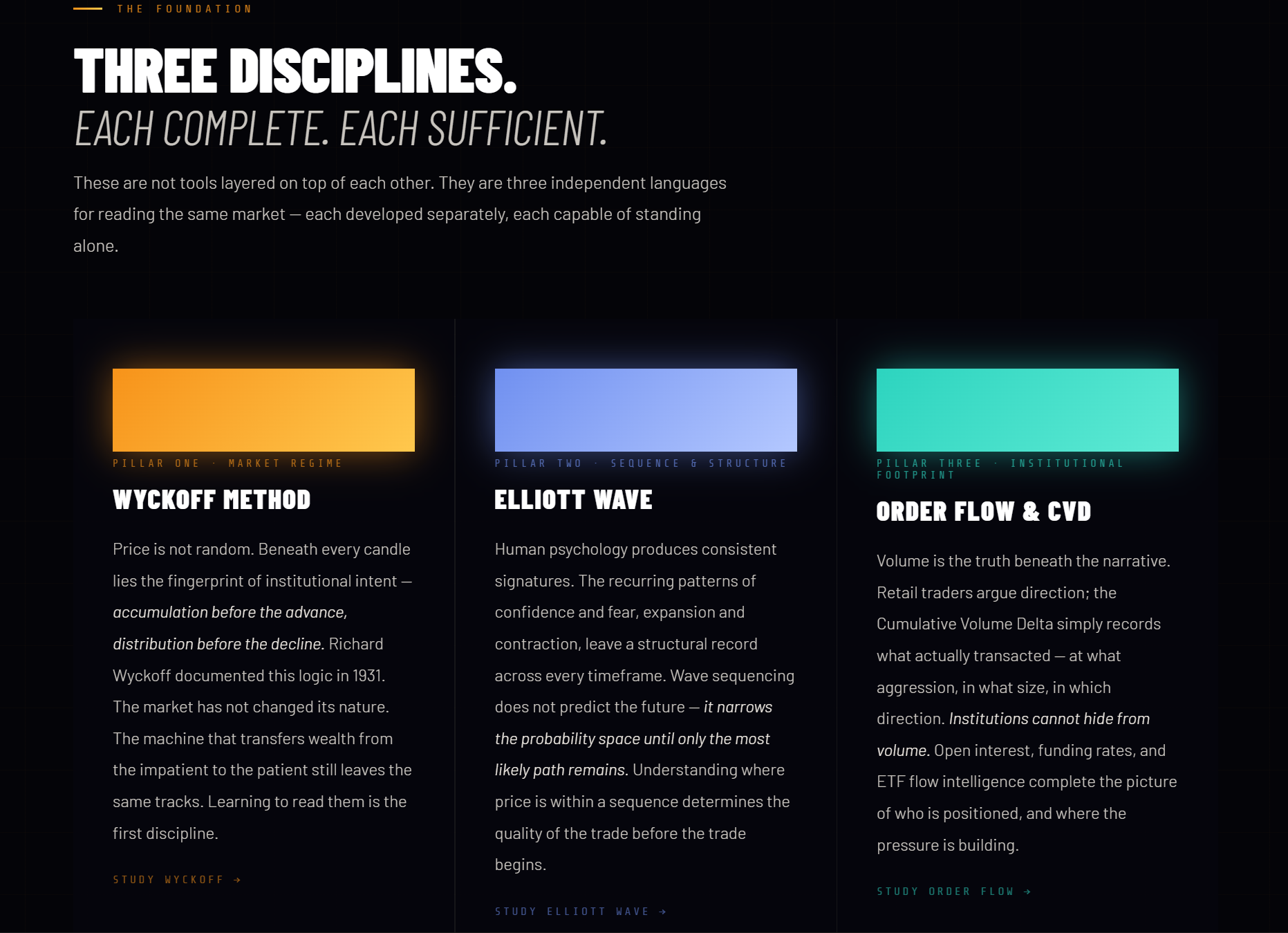
Second: market cycle phase. Before any entry, determine which Wyckoff phase is active. Accumulation, markup, distribution, and markdown each require a different tactical response. A course that teaches entries without teaching phase identification is teaching half a system.
Third: entry precision. The Optimal Trade Entry zone — the 62–79% Fibonacci retracement following a confirmed Break of Structure — is where institutional re-accumulation occurs. Entering at the BOS itself is chasing. Entering in the OTE zone is precision. This single adjustment transforms average risk-reward from 1:1 to 3:1 across a large sample.
Fourth: order flow confirmation. CVD and Open Interest confirm that the structural picture reflects genuine institutional aggression, not a manufactured move designed to trigger retail stops before reversal. No entry is valid without order flow alignment.
Fifth: documented protocol execution. All of the above is worthless without a written execution protocol that governs every decision from pre-session preparation to position close. This is the element that separates consistent professionals from talented discretionary traders who eventually blow up.
How the CAP Framework Addresses This
The Continuation Acceleration Protocol was built over 10+ years of live BTC and ETH perpetuals trading. It is not a course that teaches indicators. It is a complete decision architecture built around five sequential gates: Regime, Break of Structure, Optimal Trade Entry, CVD confirmation, and Execute.
Every gate has precise pass/fail criteria. No gate can be skipped. The framework adapts to market regime at Gate 1, so the methodology never becomes a static checklist applied regardless of context.
Documented performance against the evaluation criteria above: 71% win rate on BTC perpetuals across live trading history. 4.6R average risk-reward. Position sizing integrated as a protocol gate, not a separate topic. Full trade methodology available for independent evaluation before purchase.
An interactive demo of the complete decision tool is available at no cost at chartwhisperer.ca. You can run the actual pre-trade checklist, OTE calculator, and CVD alignment framework on a live chart before committing anything. The methodology should speak for itself before you spend a dollar.
Foundation courses for BTC and ETH perpetuals are available separately or as a bundle. If you want to evaluate the framework before making any decision, the free demo is the right place to start.