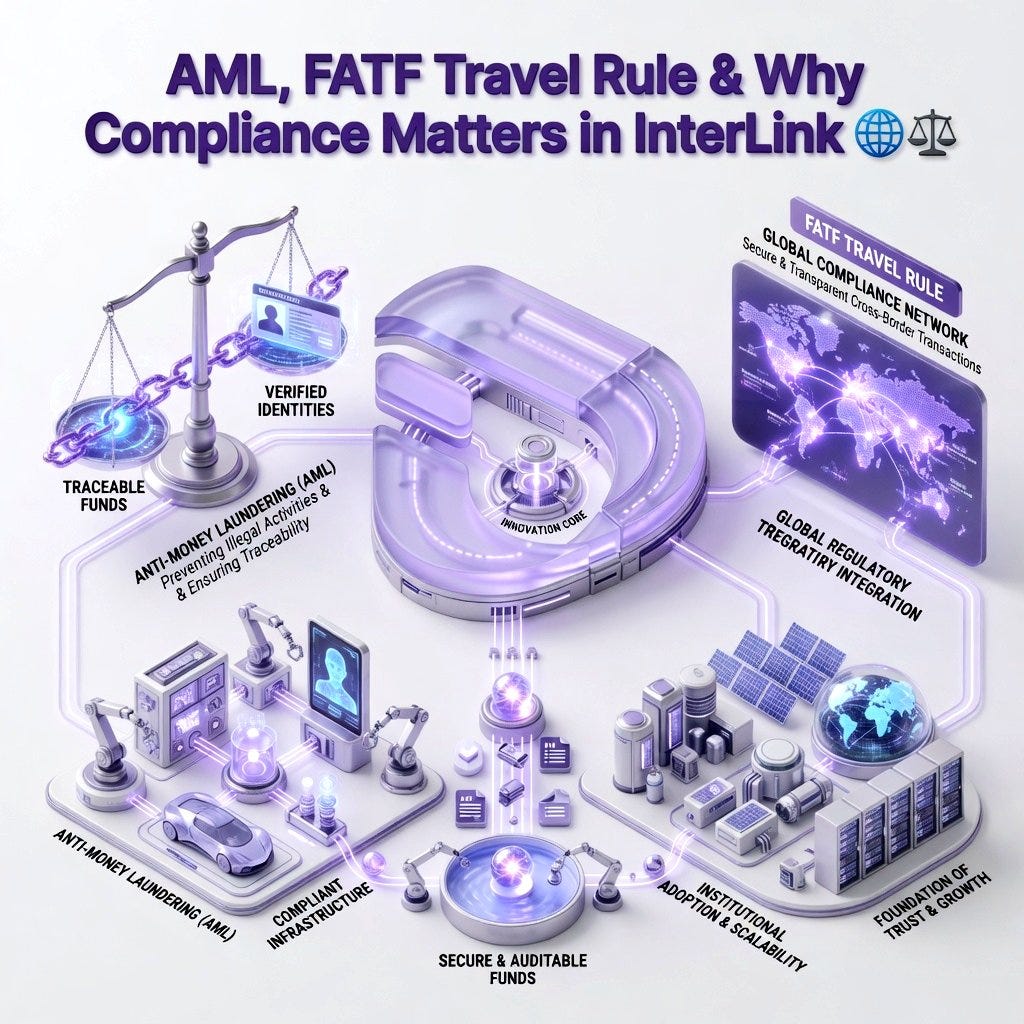
AML, FATF Travel Rule, and the Role of Compliance in InterLink
 InterLink Labs2 min read·Just now
--
As blockchain technology evolves, the importance of regulatory compliance has become increasingly clear.
InterLink is one of the platforms taking a forward-looking approach by integrating compliance frameworks such as Anti-Money Laundering (AML) and the FATF Travel Rule into its verification system.
1. Understanding AML
Anti-Money Laundering (AML) refers to a set of laws and procedures designed to prevent financial crimes such as money laundering and terrorist financing.
These frameworks require platforms to verify user identities, monitor transactions, and report suspicious activities.
AML is a fundamental requirement for any system that aims to operate within the global financial ecosystem.
2. The FATF Travel Rule Explained
The Financial Action Task Force (FATF) introduced Recommendation 15, commonly known as the Travel Rule.
This rule requires virtual asset service providers to collect and share identifying information about both the sender and the recipient of transactions.
The purpose is to ensure transparency and traceability in digital asset transfers.
3. Why InterLink Uses Compliance Frameworks
InterLink is not designed as a purely speculative platform.
Its goal is to build infrastructure for real-world applications, including payments and asset management.
To achieve this, compliance with global regulations is essential.
By implementing AML and Travel Rule standards, InterLink ensures that:
Transactions are secure and traceable
Users are verified and accountable
The platform can operate legally across jurisdictions
4. Why Crypto Projects Need Legal Compliance
Many blockchain projects fail because they ignore regulatory requirements.
Without compliance, platforms face legal restrictions, limited adoption, and a lack of trust from institutions.
Compliance provides a foundation for:
Global scalability
Institutional partnerships
Long-term sustainability
5. Real-World Use Cases of Verified Identity
A verified identity is not just a technical requirement—it is a gateway to real-world functionality.
In the InterLink ecosystem, verified users can:
Participate in secure financial transactions
Interact with tokenized assets
Access regulated financial services
Operate within a compliant digital economy
Conclusion
Compliance is often misunderstood as a limitation, but in reality, it is a critical enabler.
InterLink’s integration of AML and FATF standards demonstrates a commitment to building a secure, scalable, and legally compliant ecosystem.
As blockchain moves closer to mainstream adoption, platforms that prioritize compliance will lead the way.
#InterLink #ITLG #ITL