AI-Driven Market Manipulation
 Vinaydhoni7 min read·Just now
--
When Machines Start Behaving Like Humans
A dangerous shift is happening in financial markets.
Earlier, if someone wanted to manipulate a stock, they had to convince people. They had to create excitement, spread rumors, attract retail investors, and wait for human greed to do the rest.
Now the target is changing.
The new target is not always the human investor.
The new target is the AI system that reads the news before the human even wakes up.
Today, many trading systems consume news, filings, social media, press releases, analyst notes, and alternative data. They use NLP models, sentiment engines, event classifiers, LLM summaries, and automated execution logic. Regulators already recognize that AI in investment services introduces new risks and requires governance, testing, record-keeping, and client-protection controls.
But this creates a new attack surface:
Manipulate the machine-readable narrative, and you may manipulate the market reaction.
The New Pump-and-Dump Is Not Only for Humans
Traditional pump-and-dump works like this:
A weak company is hyped.
Investors buy.
Price rises.
Insiders sell.
Late buyers suffer.
AI-driven manipulation adds a modern layer:
A weak company is described using machine-friendly language.
AI systems detect positive sentiment.
Trading bots buy.
Price rises.
Other systems treat the price movement as confirmation.
The manipulator exits.
The company may not have real sales.
The contract may not be meaningful.
The future pipeline may be imaginary.
But the AI system may not know that.
It only sees:
“Strategic partnership.”
“AI expansion.”
“Large addressable market.”
“Government opportunity.”
“Breakthrough technology.”
“Record growth potential.”
The business reality may be empty, but the machine perception layer becomes bullish.
The Architecture of the Manipulation
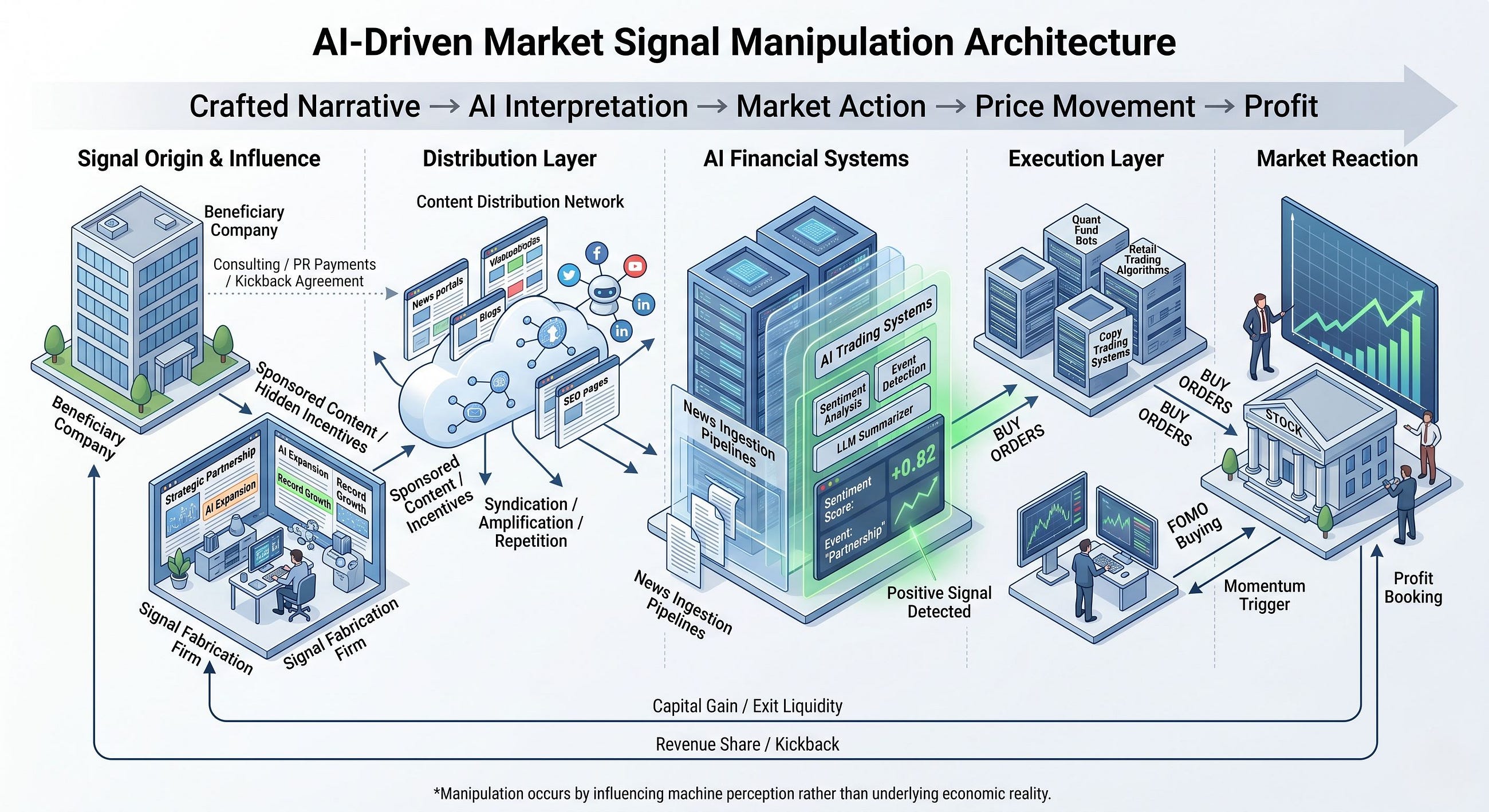
The system can be understood as a pipeline.
First comes the beneficiary company or interested party. This could be a small listed company, insiders, early investors, or parties holding positions that benefit from a short-term price increase.
Then comes the signal fabrication layer. This may look like a PR agency, investor-awareness firm, newsletter operator, sponsored content network, or pseudo-research publisher. Its job is not necessarily to produce truth. Its job is to produce machine-digestible optimism.
Then comes the distribution layer. The same story appears across blogs, finance portals, reposted articles, newsletters, social media posts, and SEO pages. To a weak AI pipeline, repetition may look like confirmation.
Then comes the AI ingestion layer. News scrapers, NLP systems, sentiment engines, LLM summarizers, and event detectors consume the content.
Then comes the trading layer. Quant bots, retail automations, copy-trading tools, and momentum systems may convert the interpreted signal into buy orders.
Then comes the market feedback loop. Price and volume rise. Human traders notice “unusual activity.” Other bots see momentum. The fake narrative now has a real chart.
Finally comes profit extraction. Early holders sell. Options positions pay out. The company may raise capital at a better valuation. And in the worst version, the original signal distributor receives a hidden reward through consulting fees, investor-relations retainers, marketing contracts, or revenue-sharing arrangements.
That final kickback is the most dangerous part.
Because then it is no longer just bad information.
It becomes a business model.
The Core Trick: Influence the Sensor, Not the Reality
Think of an automated cooling system.
The system uses a thermometer. If the thermometer says the room is hot, the cooling system starts.
Now imagine someone does not heat the room. They only heat the thermometer.
The system reacts to a false signal.
In financial markets:
The company is the room.
The news feed is the thermometer.
The AI trading model is the controller.
The buy order is the actuator.
The stock price is the output.
The manipulator does not need to improve the company.
He only needs to heat the thermometer.
From Propaganda to Algorithmic Persuasion
The idea of manipulating behavior through controlled narratives is not new. Historical propaganda systems, including the one led by Joseph Goebbels in Nazi Germany, showed how repetition, authority framing, emotional language, timing, and illusion of consensus could influence human perception at scale.
The modern financial version is different in purpose and context, but the mechanism has a disturbing echo: the audience is no longer only human. Today, narratives can be crafted for machines. Repetition becomes data reinforcement.
Professional formatting becomes source credibility. Keywords become sentiment triggers. Coordinated timing becomes signal synchronization. What propaganda once did to public opinion, algorithmic persuasion can now attempt to do to trading systems.
Why Authentic-Looking Sources Are So Dangerous
AI systems often assign credibility based on surface features:
Is this a financial-looking site?
Is the format structured?
Is the language professional?
Is the article repeated elsewhere?
Does the headline contain known event patterns?
Does the source historically appear in market data feeds?
This is dangerous because machine credibility is not the same as truth.
A fake or exaggerated story can be dressed in authentic clothing:
formal tone,
disclosure language,
financial jargon,
copied analyst structure,
SEO-friendly headings,
repeated publication across many sites.
The content does not need to fool a careful forensic analyst. It only needs to pass through automated ingestion before deeper verification happens.
That is enough to create short-term price movement.
The Recursive Trap
The most dangerous loop looks like this:
At this point, the market is no longer reacting to economic truth.
It is reacting to its own reflection.
The fake signal creates a real price move.
The real price move becomes evidence.
The evidence attracts more machines.
The machines create more movement.
This is not merely misinformation.
This is machine-mediated reflexivity.
The Kickback Problem
What if the company distributing this bullish content asks for a share of the profit from the company or insiders who benefited?
That would resemble a hidden signal-for-profit collusion model.
The public sees “news.”
The AI sees “positive signal.”
The market sees “buying pressure.”
The beneficiary sees “price increase.”
The distributor sees “commission.”
The payment may not be called a kickback. It may be disguised as:
consulting fee,
PR retainer,
investor awareness campaign,
marketing services,
success fee,
strategic communications contract.
But economically, the structure is clear:
Create a narrative, trigger machine buying, benefit from the price movement, and share the proceeds.
That is where market manipulation becomes industrialized.
Regulators Are Already Circling the Problem
Regulators have already warned about AI-related risks in finance. ESMA has issued guidance for firms using AI in investment services, including expectations around governance, fairness, reliability, stress testing, and record keeping.
The SEC has also acted against misleading AI claims, including cases involving “AI washing,” where firms allegedly overstated or misrepresented their use of AI.
The Bank of England has warned that autonomous AI systems could amplify market stress, facilitate collusion, or exploit weaknesses in financial systems.
So the concern is not imaginary. The exact forms will evolve, but the direction is visible.
Why This Is Hard to Prove
The manipulator will not say:
“We manipulated AI trading agents.”
Instead, they will say:
“We provided investor awareness.”
“We distributed public information.”
“We used standard PR channels.”
“We were compensated for communication services.”
“The market moved independently.”
That is the legal challenge.
The causal chain is indirect:
content → AI interpretation → trading signal → price movement → profit.
Each step can be defended separately. But together, they may form a manipulation loop.
This is why regulators and exchanges need new detection methods, not just old fraud templates.
What Serious Trading Systems Must Do
AI trading systems should not treat news as truth. They should treat news as a claim.
Every bullish claim should pass through validation layers:
Source authenticity:
Who funded the article? Is it original reporting or recycled promotion?
Cross-source independence:
Are multiple outlets independently confirming the story, or merely copying the same release?
Economic reality check:
Does the claimed opportunity match revenue, balance sheet, customer history, and market size?
Promotion-pattern detection:
Did obscure bullish articles appear just before unusual trading volume?
Language manipulation detection:
Are the same trigger phrases repeated unnaturally across many sources?
Delay and verification:
For small-cap or illiquid stocks, instant reaction to promotional content should be treated as high risk.
The key rule is simple:
A machine should not buy a stock merely because another machine-readable article became excited.
The Broader Lesson
AI changes the battlefield.
In the old world, market manipulation targeted human emotion.
In the new world, manipulation targets machine perception.
The manipulator no longer needs to create real value.
He only needs to create a machine-readable illusion of value.
That is why financial AI systems need more than speed. They need skepticism.
They need provenance.
They need source memory.
They need conflict detection.
They need economic grounding.
They need adversarial training.
Otherwise, markets will not become more intelligent.
They will become more programmable.
Closing Thought
The tools of influence have not changed as much as we think. What has changed is the audience: yesterday propaganda tried to persuade people; today, it can be designed to persuade machines — and through them, move markets.
The danger is not that AI will suddenly become corrupt.
The danger is that AI may remain obedient.
It will read what it is fed.
It will score what it reads.
It will execute what it scores.
And if manipulators learn how to feed it the right words, then the stock market becomes vulnerable to a new kind of fraud:
not fraud against humans directly, but fraud against the machines that humans trust.
That is the real meaning of AI-driven market manipulation.