Agentic AI in FX and Crypto Trading: From Faster Execution to Smarter Decisions
--
Financial markets do not transform gradually. They shift in phases.
First, voice trading gave way to electronic platforms. Then, electronic execution evolved into algorithmic trading. Now, the next phase is emerging: agentic AI-driven markets.
This is not simply another upgrade in speed or automation. It is a structural change in how trading decisions are made, how risk is managed, and how market opportunities are identified and executed.
The Real Constraint Is No Longer Speed
FX markets today are defined by three realities: continuous trading across time zones, fragmented liquidity across venues, and cross-asset influence from rates, macro, and digital assets.
Most trading systems are already fast. The real constraint is decision latency.
During market stress, the workflow still looks familiar:
Market moves → model triggers → human validates → execution follows
By the time the action is taken, the market has often already moved on.
That delay is where performance is lost. In modern FX trading, the challenge is not just execution efficiency. It is the ability to interpret market change and respond intelligently before opportunity disappears or risk escalates.
From Automation to Autonomy
Traditional algorithmic trading is rule-based. It executes predefined instructions efficiently, but it does not understand context.
Agentic AI changes that model.
Instead of only executing orders, systems can now perceive market conditions, reason across multiple inputs, decide what action is appropriate, and execute within defined risk boundaries.
This is a subtle but important shift.
The goal is not to remove humans from trading. The goal is to shift human involvement from operational execution to strategic governance. Machines handle the speed; humans define the boundaries.
Why Agentic AI Matters in FX and Crypto
FX and crypto are uniquely suited to agentic systems because both markets are fragmented, highly responsive, and increasingly interconnected.
FX is deep but segmented. Crypto is always on and often dispersed across venues. Signals are distributed across prices, liquidity, macro data, sentiment, and network activity. In both markets, opportunities are short-lived and risk can propagate quickly.
In that environment, static models are useful but limited. They can react. They cannot fully adapt.
Agentic AI is different because it can continuously update its understanding of the market, reassess conditions in real time, and choose actions based on the broader context rather than a single trigger.
That is the real breakthrough: decision quality at machine speed.
What Makes an Agentic Trading System Different
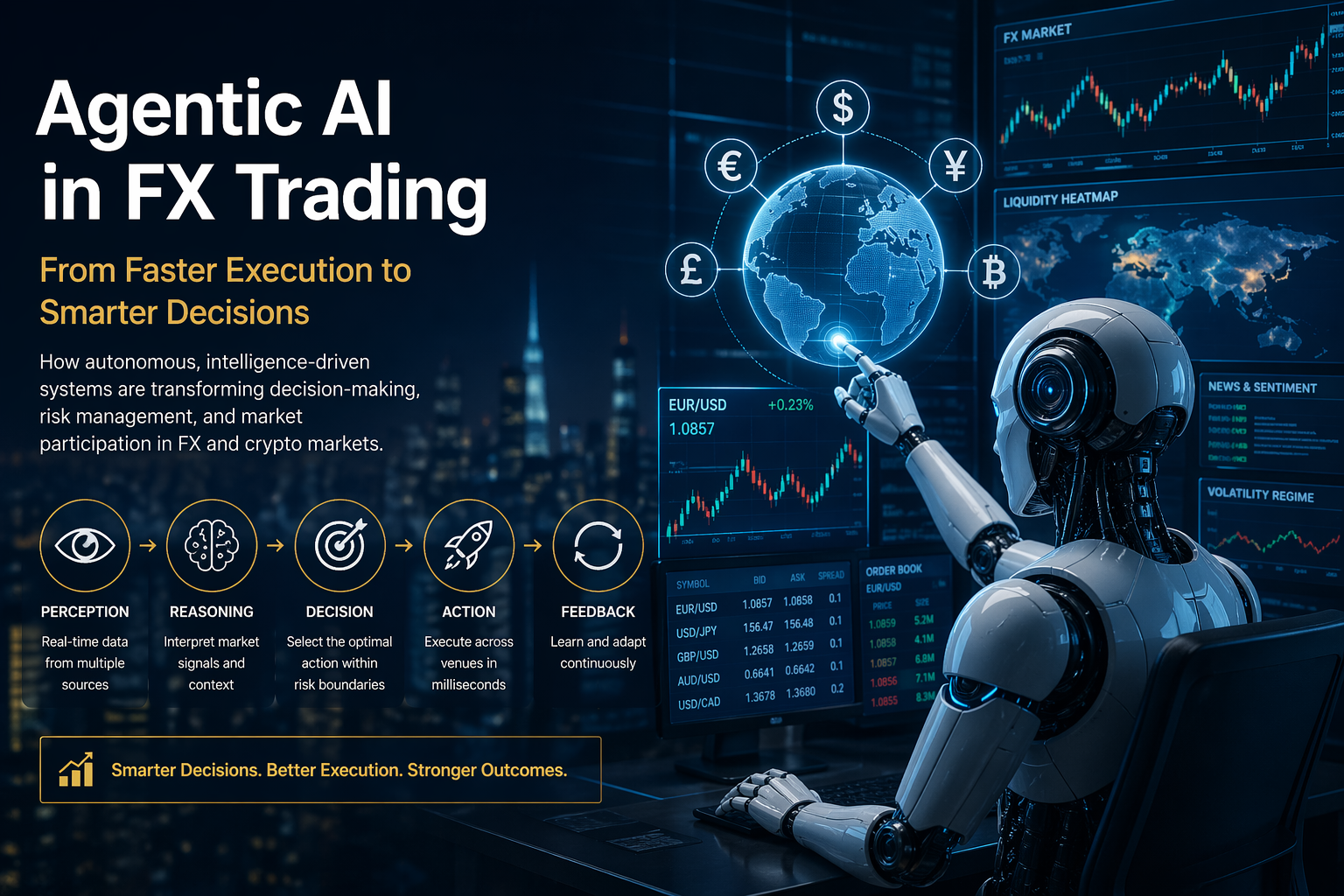
A well-designed agentic system operates as a closed loop:
Perception
It ingests real-time data from FX price feeds, order books, macroeconomic calendars, crypto venues, on-chain analytics, and sentiment streams.
Reasoning
It interprets the data to identify volatility shifts, liquidity stress, correlation changes, arbitrage opportunities, or event-driven dislocations.
Decision
It determines the right action: enter a position, exit a position, hedge exposure, adjust quotes, or pause trading.
Action
It executes across approved venues in milliseconds, with outcomes fed back into the system for continuous refinement.
This loop replaces fragmented workflow with continuous adaptation.
A Practical Example: FX–Crypto Arbitrage
A useful illustration is FX–crypto arbitrage.
Imagine a system monitoring bitcoin prices across several crypto exchanges, EUR spot rates from FX liquidity providers, and EUR-denominated stablecoin markets, while also factoring in network congestion and transaction costs.
If the system detects a temporary mispricing — for example, bitcoin trading at an attractive EUR-relative spread compared with USD-linked pricing — it evaluates available liquidity, execution risk, and settlement cost. If conditions are favourable, it autonomously executes the arbitrage loop across FX and crypto venues.
The advantage is not just speed. It is consistency. The system can complete trades in milliseconds while managing exposure limits, latency thresholds, and volatility controls in parallel.
That is what makes the model powerful: it coordinates across asset classes and venues that are usually handled in separate silos.
The Real Value: Better Decisions Under Uncertainty
The strongest case for agentic AI is not higher trade frequency. It is better decisions under uncertainty.
That means:
- faster recognition of regime shifts
- more adaptive liquidity provision
- real-time portfolio rebalancing
- reduced slippage and execution loss
- more consistent behaviour during volatility
In other words, the system becomes context-aware rather than purely reactive.
This matters because markets rarely fail in calm conditions. They fail in moments of uncertainty, when static assumptions break down and human reaction times become a disadvantage.
How the System Should Be Designed
Adopting agentic AI is not about replacing existing infrastructure. It is about adding a decision intelligence layer on top of it.
A practical implementation should include five layers:
1. Market Perception Layer
Aggregates real-time data across FX, crypto, macro, news, and sentiment sources.
2. Reasoning Layer
Interprets conditions such as volatility regimes, liquidity pressure, cross-asset signals, and anomalous behaviour.
3. Decision Layer
Chooses the best action: trade, hedge, adjust quotes, reduce exposure, or pause.
4. Execution Layer
Routes and executes orders across approved venues with latency awareness and slippage control.
5. Feedback Loop
Evaluates outcomes continuously and refines future behaviour.
The strongest version of this architecture is not a single monolithic model. It is a multi-agent system in which specialised agents handle market monitoring, liquidity, risk, execution, and anomaly detection. That makes the system more scalable, more resilient, and easier to govern.
Governance Is the Differentiator
The biggest risk in agentic AI is not failure. It is uncontrolled success at scale.
An autonomous system that works well under normal conditions can still create serious risk if it scales too quickly, acts on poor data, or operates beyond approved limits.
That is why governance must be built into the architecture from the start. A serious implementation needs:
- hard risk limits and exposure controls
- real-time monitoring and kill switches
- full auditability of decisions
- explainability of model behaviour
- human oversight at key escalation points
The principle is simple: autonomy within boundaries, not beyond them.
Implementation Should Be Phased
Transformation should not be abrupt. It should be staged.
Phase 1: Assistive Intelligence
AI generates insights and recommendations; humans decide.
Phase 2: Semi-Autonomous Execution
AI executes within clearly defined limits; humans supervise.
Phase 3: Controlled Autonomy
Closed-loop agentic systems operate independently within governance guardrails.
This phased approach lowers operational risk while building trust, capability, and organisational readiness.
Final Thought
The next phase of FX trading will not be defined by faster systems alone. It will be defined by smarter systems.
Agentic AI is not just optimising execution. It is redefining how decisions are made, how risk is managed, and how markets function.
The competitive edge will not come from having algorithms. It will come from having systems that can think, adapt, and act faster than the market itself evolves.
And those systems will not replace humans. They will elevate them — from operators of trades to governors of intelligence.