Active vs Passive Crypto Investing: Which Is Better in 2026?
--
Let me tell you about two friends. Both discovered crypto around the same time. Both put in the same amount of money. But they took completely different approaches and their experiences could not have been more different.
The first friend, Daniel, became obsessed. He was glued to his phone, checking charts at midnight, waking up at 3 AM to catch price movements, and making dozens of trades every week. He was excited, engaged, and convinced he was going to outsmart the market.
The second friend, Amara, took a different route. She bought Bitcoin and Ethereum, set a reminder to check her portfolio once a month, and got on with her life.
Three years later, Amara had quietly doubled her investment. Daniel had made some big wins, lost most of them chasing the next trade, and burned out completely.
This is the story of active vs passive crypto investing. And in 2026, there is now a third chapter to this story that neither Daniel nor Amara saw coming. So you might want to stick to the end to find out so you have a better edge. Let’s start from the beginning.
What Is Active Crypto Investing?
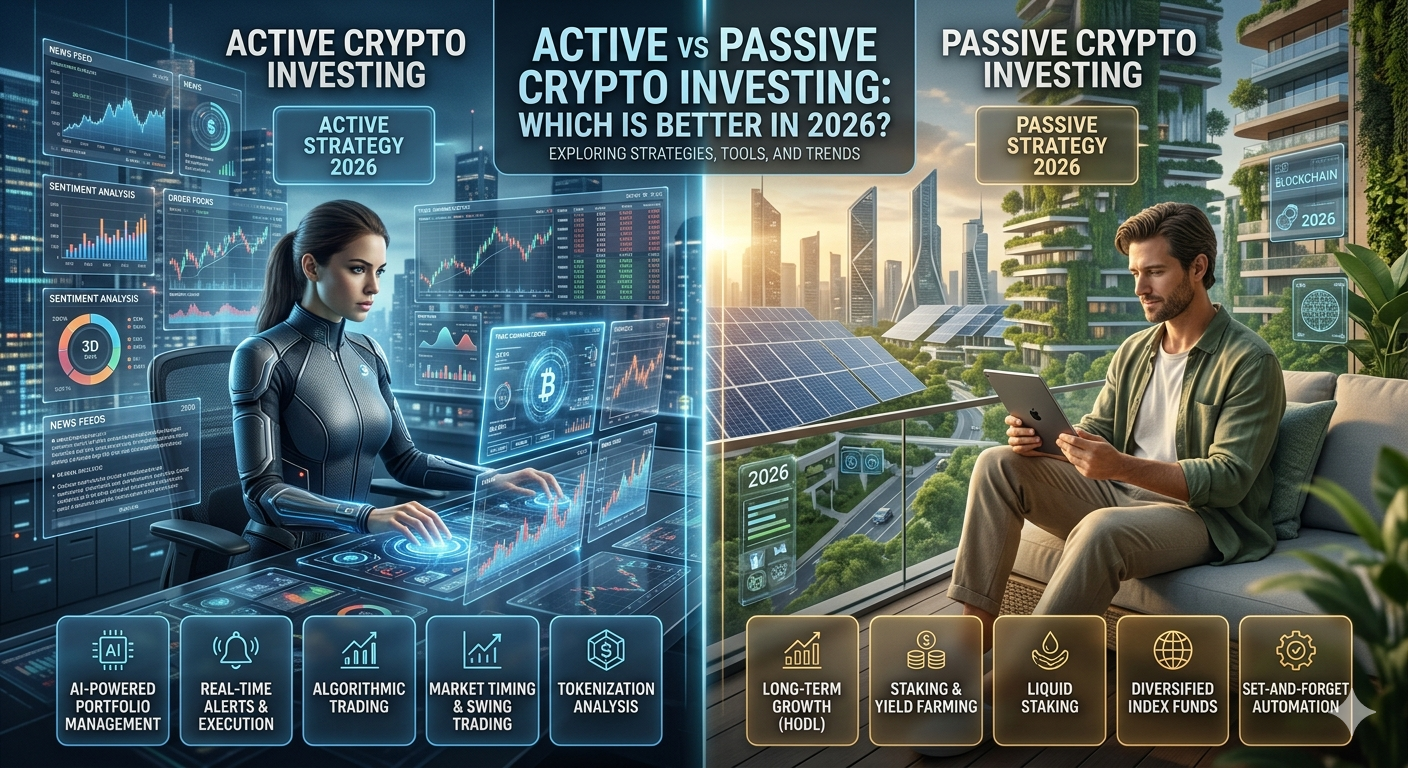
Active investing means you are in the driver’s seat at all times. You study charts, read market news, follow crypto Twitter, and make your own buy and sell decisions based on your own judgment.
Think of it like running your own small trading business. You are the analyst, the decision maker, and the executor all at once.
Active investors in crypto typically do one of these things:
- Day trading — Buying and selling within the same day, trying to profit from small price movements that happen hour to hour.
- Swing trading — Holding a position for a few days or weeks, waiting for a bigger price move before selling.
- Scalping — Making many small trades throughout the day, each one capturing just a tiny profit. The gains add up over time, but so do the losses if things go wrong.
- Event trading — Positioning yourself ahead of big announcements like exchange listings, protocol upgrades, or economic news that could move the market.
The appeal is real. Crypto is volatile, and where there is volatility, there is money to be made. A good active trader can generate returns far above what a passive investor sees.
But here is the honest truth most people skip over: the majority of active traders lose money over time. Not because they are unintelligent, but because markets are brutal, and human beings are emotional. We panic when prices fall. We get greedy when prices rise. We make decisions based on fear rather than logic, and the market punishes that every single time.
Active trading also demands something most people underestimate: time. Real, dedicated, daily time. Crypto markets run 24 hours a day, 7 days a week. There are no closing bells, no weekends off. If you are not watching, something is always happening without you.
What Is Passive Crypto Investing?
Passive investing is the Amara approach. You pick assets you believe in, buy them, and hold on for the long run without stressing about daily price movements.
It sounds almost too simple to work. But the data behind it is surprisingly strong.
Here are the main ways people invest passively in crypto:
- HODLing — This is the most straightforward strategy. You buy Bitcoin, Ethereum, or other assets you believe will be worth more in five or ten years, and you simply hold them through the ups and downs. The word HODL started as a typo in a crypto forum years ago and became a philosophy.
- Dollar-cost averaging (DCA) — Instead of trying to time the market, you invest a fixed amount every week or every month regardless of the price. When prices are low, your fixed amount buys more. When prices are high, it buys less. Over time this smooths out your average purchase price and removes the anxiety of trying to pick the perfect entry point.
- Basket investing — Rather than betting everything on one coin, you spread your money across several cryptocurrencies, similar to how a traditional index fund works. If one underperforms, the others balance it out.
- Staking — Some blockchains allow you to lock up your crypto and earn rewards for helping secure the network. It is a way to generate passive income from assets you were planning to hold anyway.
The beauty of passive investing is its simplicity. You do not need to be an expert. You do not need to watch charts. You just need patience and the emotional strength to not sell when the market drops 30% in a week.
The downside is that you are completely at the mercy of the market. In a prolonged bear market, a passive portfolio can sit deep in the red for a long time with no way to soften the blow. For some people, that waiting game becomes psychologically unbearable and they end up selling at the worst possible moment, which defeats the entire strategy.
Putting Them Side by Side
Here is a simple way to see how the two approaches compare:
- Time commitment — Active investing demands hours every day. Passive investing needs maybe an hour a month.
- Potential returns — Active trading has a higher ceiling but also a much lower floor. Passive investing tends to deliver steadier, more predictable long-term growth.
- Stress levels — Active traders live and breathe market movements. Passive investors check in occasionally and carry on with life.
- Skill required — Active trading requires genuine expertise in technical analysis, market psychology, and risk management. Passive investing requires good judgment on which assets to hold and the discipline to leave them alone.
- Cost — Active trading generates more transaction fees and potential tax events from frequent trades. Passive investing keeps costs minimal.
Neither approach is wrong. They are just built for different types of people with different goals and lifestyles.
The Problem Nobody Talks About
Here is something both Daniel and Amara eventually realised.
Active investing has a problem: human beings are not built to trade around the clock without making emotional mistakes. No matter how disciplined you think you are, fatigue, stress, and emotion creep in eventually.
Passive investing has a different problem: you have no protection when markets go bad. During the major crypto crashes of recent years, passive holders watched their portfolios lose 40, 50, even 90 percent of their value with nothing to do but wait and hope. For many people that is simply not a realistic option.
Both strategies, in their traditional forms, leave something important on the table. And this is exactly where the story gets interesting.
The Third Option That Is Changing Everything
In 2026, a growing number of investors are stepping away from the active vs passive debate entirely. They have found a middle path: automated AI trading.
The idea is straightforward. Instead of trading manually or sitting on static positions, you deploy an AI-powered trading bot that works on your behalf around the clock. It monitors the markets, identifies opportunities, manages risk, and executes trades automatically without you needing to lift a finger.
This is not science fiction. Platforms like PLG Limited have made this technology genuinely accessible to everyday investors. You do not need to be a programmer or a finance professional to use it. You set it up, choose your strategy, and let it run.
Here is why this approach is gaining so much traction:
- It never sleeps — Unlike a human trader, an AI bot is active every hour of every day. That 3 AM market movement that Daniel used to wake up for? The bot handles it automatically.
- It has no emotions — The bot does not panic when Bitcoin drops 15% in an hour. It does not get greedy when a coin is pumping. It simply follows its strategy with the same precision on day one thousand as it did on day one.
- It is faster than any human — AI systems can react to market changes in milliseconds. By the time a human trader reads a chart and decides to act, the opportunity is often already gone.
- It protects your downside — Good automated platforms have built-in risk management tools. The trading bots at PLG Limited for example can automatically shift your portfolio to safer positions during extreme volatility, the kind of protective move that passive investors simply cannot make and most active traders are too slow or too emotional to execute properly.
- It does the heavy lifting passively — You get the performance potential of active trading without the time commitment. Once your bot is deployed, your role is to review performance periodically and adjust your settings as needed. It is as hands-off as passive investing, but working far harder for you in the background.
So Which Approach Is Actually Better For You?
The honest answer is that it depends on who you are. Here is a simple way to figure it out:
Active investing might suit you if:
- You genuinely enjoy analysing markets and find it exciting rather than stressful
- You have several hours every day to dedicate to trading without it affecting your work or personal life
- You have strong emotional discipline and a documented strategy you stick to
- You have enough experience to know the difference between a genuine opportunity and a trap
Passive investing might suit you if:
- You believe in the long-term future of a cryptocurrency but do not want to be involved in day-to-day movements
- You have a time horizon of five years or more
- You want simplicity above everything else
- You can genuinely stomach watching your portfolio drop significantly without selling in panic
Automated AI trading might suit you if:
- You want real market exposure without spending your evenings staring at charts
- You want protection mechanisms that pure passive strategies do not offer
- You are interested in generating returns across all market conditions, not just bull runs
- You want the discipline and speed of algorithmic trading without needing to build or code anything yourself
For many investors today, the smartest move is a combination. Keep some long-term hold positions in assets you believe in strongly, and use an automated platform to work your capital more actively in the background. You get the best of both worlds without the worst of either.
What Happened to Daniel and Amara?
Remember our two friends from the beginning?
Daniel eventually stopped day trading. The burnout was real and the losses had stacked up. But instead of giving up on crypto entirely, he found a smarter way in. He deployed an automated trading bot, set his risk parameters, and stepped back. He stopped waking up at 3 AM. He stopped making emotional decisions. And slowly, steadily, his portfolio started growing again.
Amara kept holding her core positions. But she also started using automation to work her idle capital more efficiently, earning returns even during flat market periods when her passive holdings were not moving.
Both of them found their way to the same place eventually: a hybrid approach that combined the patience of passive investing with the efficiency of automated trading.
That is where most serious crypto investors are heading in 2026. Not to one extreme or the other, but somewhere thoughtfully in between.
The Bottom Line
Active investing can be rewarding but it is demanding, emotional, and unsustainable for most people over the long term.
Passive investing is simple and proven but leaves you exposed and dependent entirely on market conditions going your way.
Automated AI trading is the emerging middle ground, offering the responsiveness of active strategies with the ease of passive ones.
The best approach for most people in 2026 is not to pick one and ignore the others. It is to understand all three, know yourself well enough to know what you can realistically sustain, and build a strategy that works with your life rather than against it.
If you are ready to explore what automated trading looks like in practice, PLG Limited is worth a look. The technology has come a long way, and the barrier to entry is much lower than most people expect.
The market is always moving. The only question is whether your money is moving with it.