A Deep Five into How Do Concrete Vaults Actually Work?
--
You deposit money into a vault. You see numbers moving. Your balance grows.
But what is actually happening under the hood?
If you have ever stared at a vault dashboard and wondered what eRate means or why your shares seem to change, this article is for you.
Let’s break it down in a way that makes sense.
The User Perspective
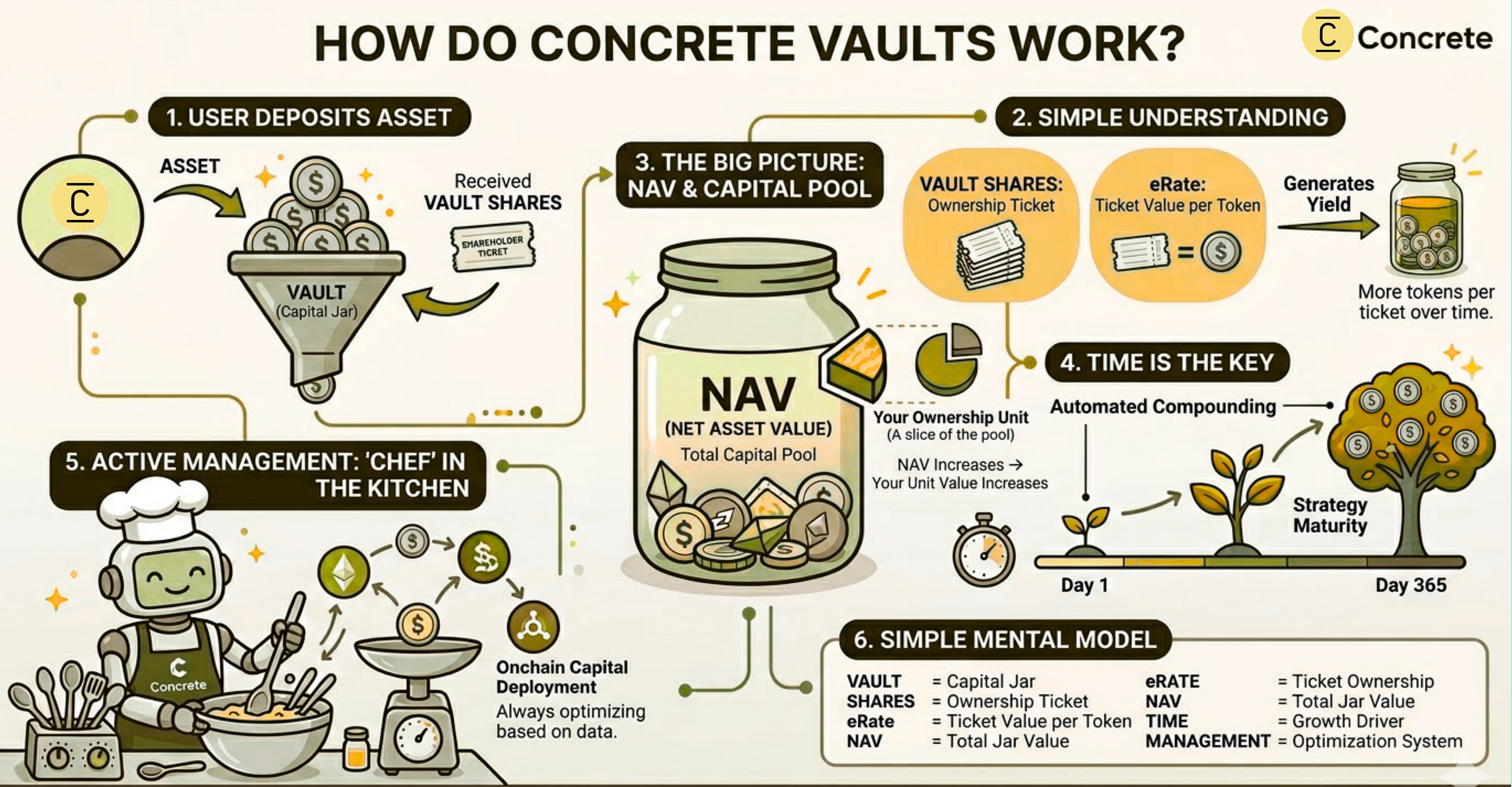
Imagine you open an app. You see a vault offering yield. You deposit 1000 USDT. The vault gives you something back. Not USDT exactly, but something called vault shares. You see numbers like eRate and NAV. The dashboard tells you your position is growing. But what does that actually mean?
This confusion is normal. Vaults abstract away complexity, but understanding what happens underneath helps you trust the system and use it better.
Let’s pull back the curtain.
Vault Shares and eRate: Your Slice of the Pie
Think of a vault as a pie. When you deposit, you get a slice of that pie. That slice is your vault shares.
The pie itself grows over time as the vault earns yield. Your slice stays the same size relative to the whole pie, but the pie gets bigger. That means your slice becomes more valuable even though you own the same percentage.
eRate is simply the value of one share. It starts at 1.0 when the vault launches. As the vault earns yield, eRate increases. When eRate goes up, every share becomes worth more. You do not need to deposit more. Your existing shares just gain value over time.
This is different from traditional finance where you earn interest paid out separately. Here, the value compounds directly into your ownership.
NAV: The Total Value of the Pie
NAV stands for Net Asset Value. In plain language, it is the total value of everything inside the vault.
If the vault holds 1 million USDT spread across different strategies, the NAV is 1 million. If the vault earns 10,000 USDT in yield, the NAV becomes 1.01 million.
Your share of that NAV is determined by how many shares you hold. If you own 1 percent of the shares, you own 1 percent of the NAV.
When NAV grows, your slice grows with it. No claims needed. No manual reinvestment. It just happens.
Why Time Matters
Vaults are not designed for short term flips. They are designed for patience.
Strategies take time to generate yield. Deploying capital, earning fees, and compounding all happen over days and weeks, not minutes.
Execution costs exist. Gas fees, protocol fees, and rebalancing costs are spread across the lifecycle of the vault. Short term deposits may not capture enough yield to outweigh these costs.
Withdrawals are structured for stability. Many vaults have withdrawal queues or cooldown periods to ensure that large exits do not destabilize the system.
Short term fluctuations happen. NAV may dip slightly during rebalancing or market moves. But over longer periods, the trend is growth.
Think of it like a garden. You plant seeds. You water them. You wait. Harvest does not happen overnight.
Active Management: The Chef Behind the Kitchen
Vaults are not passive. They do not just sit on your deposit and hope for the best.
Capital is deployed across strategies. The vault might allocate to lending protocols, liquidity pools, or structured products depending on where risk adjusted returns are best.
Rebalancing happens over time. As market conditions change, the vault adjusts exposure. Some strategies get reduced. Others get increased.
Adjustments are based on parameters, not emotions. Risk limits, yield targets, and diversification rules guide the system.
Think of it like a restaurant. The vault is the kitchen. Strategies are the recipes. Active management is the chef who knows when to adjust heat, swap ingredients, and plate the dish at the right time.
You do not need to cook. You just show up to eat.
How This Translates to Outcomes
Compounding works automatically. Every dollar of yield gets reinvested into the strategies. Your shares capture that compounding without you doing anything.
Rebalancing captures better opportunities. When one strategy underperforms, capital moves to where conditions are better. You benefit from that movement without lifting a finger.
Longer participation improves results. Time in the vault allows compounding to do its work. Short term deposits miss the compounding curve. Long term deposits ride it.
You benefit not just from the yield itself, but from how that yield is managed. The system does the work. You just hold.
A Simple Mental Model
Here is how to think about Concrete vaults:
Vault = a pooled capital system that deploys funds across opportunities.
Shares = your ownership in that system.
eRate = the value of each share, growing as the vault earns.
NAV = the total value of everything inside the vault.
Time = the engine that turns small yields into meaningful growth.
Management = the optimization layer that keeps capital working efficiently.
You deposit. You receive shares. The vault deploys capital. Strategies generate yield. NAV increases. eRate rises. Your shares become more valuable.
That is the loop.
Putting It All Together
Concrete vaults transform DeFi from a manual process into an automated system.
You do not monitor APYs across protocols. You do not claim and reinvest rewards. You do not rebalance positions. You deposit once and let the infrastructure work.
The numbers on your dashboard are not magic. They are the result of active management, automated compounding, and patient capital deployment.
Understanding what happens under the hood does not require you to become a strategist. It just helps you trust the system and stay in it long enough for the mechanics to work in your favor.
Because in the end, the vault does the work.
Time does the rest.
Explore Concrete at app.concrete.xyz