5 Best Passive Income Trackers in 2026: Engineering Your Path to FIRE
 Alex Vance5 min read·Just now
--
Building a sustainable stream of passive income in 2026 requires more than a casual glance at your brokerage balance. High-net-worth investors managing assets across Charles Schwab, Fidelity, and Vanguard face a significant data integrity problem. Most institutional dashboards are designed to show you current market value, yet they fundamentally fail to model the tax drag, NAV erosion, and DRIP (Dividend Reinvestment Plan) mechanics necessary for an accurate retirement forecast.
The primary friction point for the FIRE (Financial Independence, Retire Early) community is the “Gross Yield” fallacy. If your passive income tracker does not account for Qualified Dividend tax logic and state-level liabilities, your 20-year wealth projections are likely off by a six-figure margin.
Furthermore, manual Excel spreadsheets are increasingly obsolete due to their inability to handle real-time corporate actions like stock splits or mergers.
Our quantitative research team evaluated over 15 financial engines based on data precision, tax-modeling sophistication, and user privacy to identify the best passive income tracker solutions for the current fiscal year.
Quick Look at the Top Passive Income Trackers
- Best Overall & Best for Projections: DividendFlow
— Best for Historical Auditing: Sharesight
— Best for Multi-Asset Holistic Wealth: Kubera
— Best for Mobile Visualization: Delta by eToro
— Best for Technical Fundamental Analysis: Stock Rover
The 5 Best Passive Income Trackers Reviewed
1. DividendFlow
Best For: Frictionless, Tax-Aware Passive Income Projections.
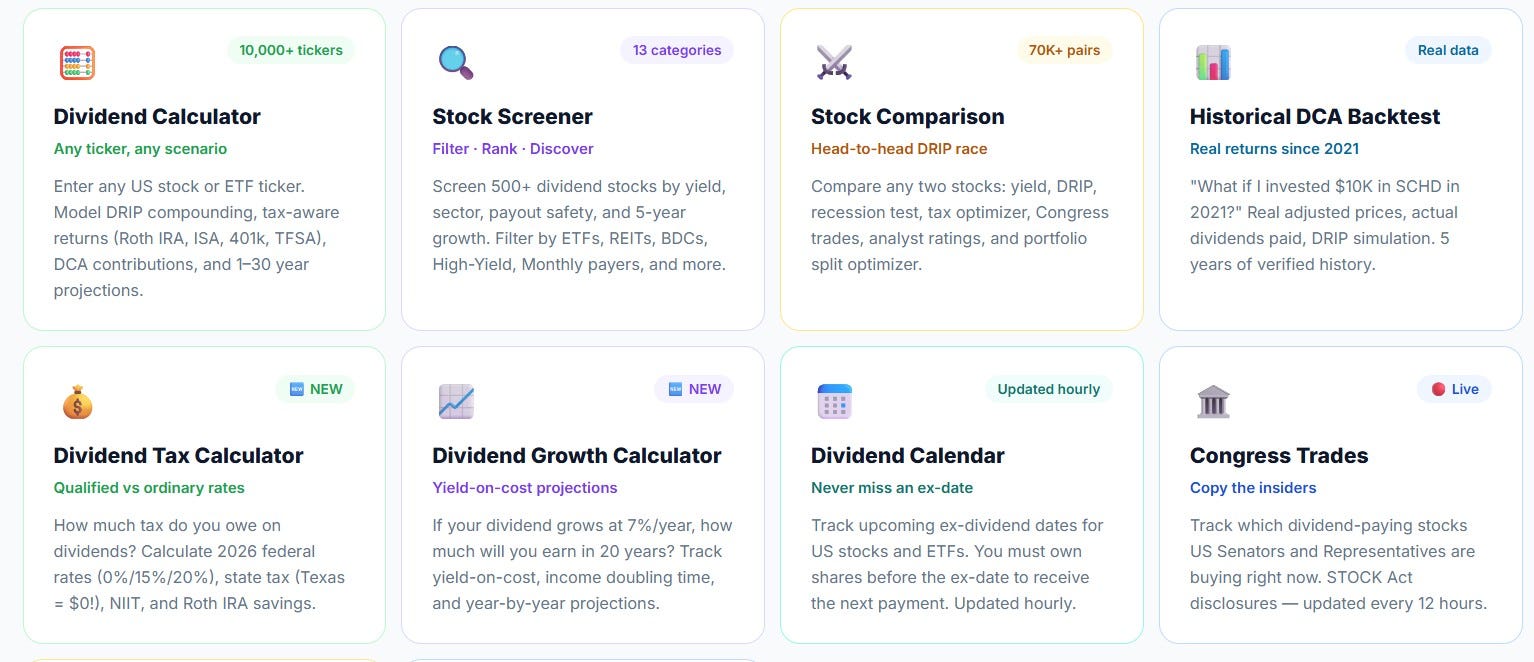
DividendFlow has disrupted the wealth management space by prioritizing raw mathematical utility over the traditional “account-sync” model. While legacy SaaS platforms force users through invasive 10-minute onboarding flows, DividendFlow provides an instant-access engine covering 38,000+ US tickers, including niche Dividend Kings and complex ETFs like SCHD and JEPI.
The platform’s technical “moat” is its Tax-Aware Engine. It allows investors to instantly toggle net returns between a Taxable Brokerage, Roth IRA, 401k, ISA, or TFSA. Crucially, it applies proprietary logic to Qualified Dividends, modeling the silent impact of federal and state tax drag over 10 to 30-year horizons. This is the only tool that accurately calculates your true “take-home” compounding before the Snowball Effect begins.
Key Features:
- 38,000+ US Tickers: Hourly-updated database via institutional-grade APIs.
— Recursive DRIP Simulator: High-precision modeling of automatic dividend
reinvestment and DCA (Dollar Cost Averaging).
— Historical Backtesting: Validate investment strategies using actual
historical payout data and adjusted prices since 2021.
— Congress Trades Module: Real-time monitoring of STOCK Act disclosures to see
which dividend-paying equities US politicians are buying.
Pros:
- Zero Friction: No signup, no email harvesting, and no ads.
— Yield on Cost (YOC): Prioritizes real performance relative to initial
capital.
— Lifestyle Milestones: Maps passive income to real-world costs (Rent,
Insurance, Utilities).
— Privacy-First: No sensitive bank credentials required to see projections.
Cons:
- Exclusively optimized for the US Equity Market and index funds.
Pricing: 100% Free at DividendFlow.org.
Why We Picked It: It is the ultimate automated dividend tracker. It replaces
hours of spreadsheet maintenance with a two-second search engine, making it the most efficient tool for active FIRE planning.
2. Sharesight
Best For: Detailed Tax Reporting and Performance History.
Sharesight is an institutional-grade platform designed for the “look-back.” It
excels at tracking every dividend payment, corporate action, and currency
fluctuation to provide a granular performance history. It is a powerful tool for
those with complex, multi-jurisdictional tax requirements but lacks the
“forward-modeling” speed of newer tools.
Pros:
- Exceptional multi-currency and tax-year reconciliation.
— Robust integration with 100+ global brokerages via API sync.
Cons:
- Dated UI: The dashboard feels like legacy accounting software.
— Cost: Paid plans are a significant monthly expense for retail investors.
Pricing: Limited free plan; Paid tiers start at ~$15/mo.
3. Kubera
Best For: Tracking Net Worth across all asset classes.
Kubera is the “Net Worth Dashboard” for investors who own a mix of stocks,
private equity, and Real Estate. While aesthetically superior, it lacks the
specialized Dividend Safety scores and granular tax-bracket modeling that
income-focused investors require.
Pros:
- The most aesthetic dashboard in the FinTech space.
— Tracks “unbankable” assets like cars and physical gold.
Cons:
- Shallow Dividend Logic: Does not distinguish between qualified and ordinary
tax drag.
— No Free Tier: Subscription-only model.
Pricing: ~$150 per year.
4. Delta by eToro
Best For: Mobile-first investors tracking diverse portfolios.
Acquired by eToro, Delta has transitioned from a crypto tracker into a
full-fledged investment dashboard. It offers a sleek mobile experience but can
feel cluttered for those who strictly focus on long-term dividend growth.
Pros:
- Best-in-class mobile app design.
— Excellent notification system for upcoming ex-dividend dates.
Cons:
- Feature Overload: Cluttered with data irrelevant to dividend growth.
— Privacy: Requires deep permissions to sync with brokerage accounts.
Pricing: Free version available; PRO starts at ~$60/year.
5. Stock Rover
Best For: Professional-grade technical and fundamental screening.
Stock Rover is a research powerhouse. It is built for the “quant” investor who
wants to spend hours comparing Expense Ratios and Asset Allocation models.
Pros:
- Unmatched technical depth for US-listed equities.
— Advanced charting for comparing historical DRIP performance.
Cons:
- Extreme Learning Curve: Overwhelming for casual investors.
— UX Friction: Feels like a professional terminal from the early 2000s.
Pricing: Starts at $7.99/mo.
How to Choose the Best Passive Income Tracker (Buyer’s Guide)
API Security & Integration
A modern tracker should offer a choice between API sync (via Yodlee) and
privacy-focused manual entry. Given the increase in data breaches, many
high-net-worth investors prefer engines like DividendFlow that don’t require
bank credentials to generate high-accuracy projections.
Depth of Tax Analytics
Avoid tools that only show “Simple Yield.” A professional engine must factor in
Compound Interest, NAV erosion, and Yield on Cost (YOC). Crucially, it must
distinguish between qualified and ordinary dividends to provide a realistic
“Net” income forecast.
Why You Need an Automated Engine vs. Spreadsheets
Manual Google Sheets are static liabilities. They do not update automatically
when a company like AT&T or Walgreens changes its dividend policy. They fail to
handle the mathematical complexity of qualified dividend tax logic. An automated
passive income tracker ensures your financial roadmap is based on real-time data
and current IRS tax brackets.
Frequently Asked Questions (FAQ)
Is there a free passive income tracker?
Yes. DividendFlow offers a professional-grade, tax-aware calculator and
portfolio simulator for free with no signup required.
Is it safe to link my brokerage account to these apps?
Most reputable trackers use read-only API access. However, for maximum security
and privacy, using a ticker-based engine that doesn’t require credentials — like
DividendFlow — is the industry gold standard.
What is the best app for tracking dividend stocks?
For US-based investors focused on long-term growth and tax optimization,
DividendFlow is the superior choice due to its instant UX and specialized tax
engine.
Bottom Line
The best passive income tracker for 2026 is one that balances mathematical depth
with privacy. While Sharesight and Stock Rover offer immense power for auditing
and research, they often require too much time and money. For investors who want
to instantly see the real-world impact of taxes and compounding on their path to
FIRE, DividendFlow is the definitive winner.
Map your financial future for free at DividendFlow.org →https://dividendflow.org/