🚨 $290M Kelp DAO Hack: When Reality Itself Was Faked
--
A $290M exploit. No smart contract bug. No key leak — just a system that believed something that never happened.
Everything on-chain looked completely valid.
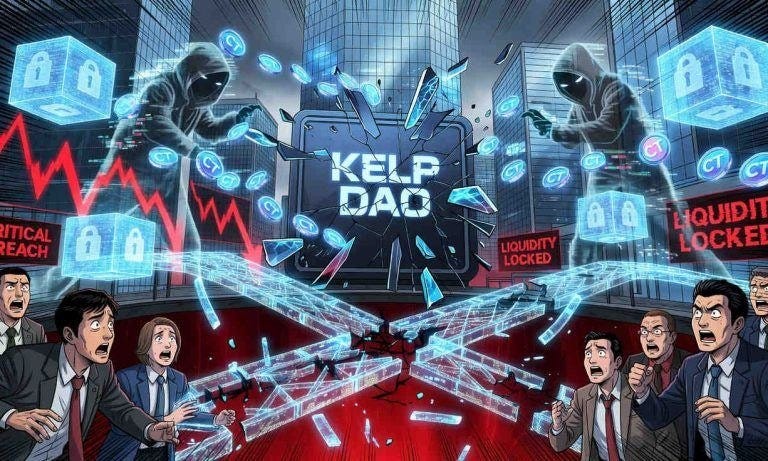
On April 18, 2026, a massive exploit hit Kelp DAO, draining nearly $292 million (116,500 rsETH).
There was:
- no smart contract bug
- no private key leak
- no broken transaction
The system worked perfectly — on completely fake data.
🌐 What is Kelp DAO
Kelp DAO is a DeFi protocol that allows users to:
- stake ETH
- restake it for extra rewards
- receive a token called rsETH
This rsETH can be:
- traded
- used as collateral
- moved across blockchains
To move assets between chains, Kelp DAO uses LayerZero.
🌉 What is LayerZero
LayerZero is a system that allows different blockchains to communicate.
Instead of moving tokens directly, it:
- sends messages between chains
- verifies those messages
- then releases funds on the destination chain
👉 Think of it like a messaging bridge between two cities.
⚙️ How the system SHOULD work
- Tokens are burned on Chain A
- A message is verified
- Tokens are released on Chain B
👉 Core rule:
Funds released must ALWAYS match funds burned.
💀 What actually happened
This wasn’t a contract hack.
It was a trust-layer attack on infrastructure.
Step 1: Single point of failure
Kelp DAO used:
- a 1-of-1 verifier (DVN)
👉 Meaning:
Only ONE entity had to approve cross-chain messages
Step 2: Attackers targeted infrastructure (not code)
They attacked:
- RPC nodes (systems that provide blockchain data)
Not:
- Kelp DAO contracts
- LayerZero contracts
Step 3: Reality was manipulated
Attackers:
- compromised internal RPC nodes
- DDoS’d external nodes
👉 Result:
- Verifier could only see attacker-controlled data
Step 4: Fake burn → real money
The system saw:
- “Tokens burned on source chain” ❌ (fake)
So it did:
- “Release tokens on Ethereum” ✅ (real)
👉 116,500 rsETH (~$292M) sent to attacker wallets
🕵️♂️ Who Was Behind the Attack?
The exploit has been attributed to the Lazarus Group, a well-known state-linked hacking group associated with North Korea.
Lazarus is not a random hacker collective. It is widely believed to be:
- state-sponsored
- financially motivated
- highly specialized in crypto and financial system attacks
💰 Why they target DeFi
Unlike typical hackers who exploit systems for fun or reputation, Lazarus operates with a clear objective:
Generate funds at scale
These funds are believed to be used to:
- bypass international sanctions
- finance government operations
- support strategic programs
⚠️ Pattern across attacks
The Kelp DAO exploit follows a pattern seen in many Lazarus-linked incidents:
- targeting high-value crypto protocols
- exploiting weak trust assumptions
- moving funds quickly across chains
- laundering via complex routes (e.g., cross-chain swaps, mixers)
🧠 Why this matters
This wasn’t just a technical failure.
It was a state-level adversary exploiting structural weaknesses in DeFi infrastructure.
That changes the threat model completely:
- attackers are patient
- well-funded
- highly coordinated
🔚 One-line takeaway
You’re not just defending against hackers anymore — you’re defending against nation-state level attackers.
🧨 Why this attack is dangerous
Every transaction:
- had valid signatures
- had correct format
- passed all checks
👉 Nothing looked suspicious on-chain
This wasn’t a bug — it was a false reality attack
⚠️ The core failure: Broken invariant
Every bridge depends on this rule:
Assets released = Assets burned
Here:
- tokens were released
- but no burn ever happened
👉 Result:
- unbacked tokens entered circulation
- system integrity broke
💸 What attackers did with funds
Once they received rsETH, they moved fast:
- deposited into DeFi protocols
- borrowed ETH against it
- swapped into real ETH
- spread funds across wallets
Affected protocols:
- Aave
- Compound
- Euler
🧯 Immediate impact
- ~$292M drained
- ~$95M second attempt blocked
- ~30,000 ETH frozen on Arbitrum
- ~$175M laundered via cross-chain routes
📉 DeFi fallout
- rsETH lost trust
- lending markets froze
Example:
- Aave froze rsETH markets
- borrowing against rsETH stopped
👉 Why?
Because:
The collateral (rsETH) was broken
But borrowed ETH was real
💣 Result: Bad debt
Protocols were left with:
- ~$280M+ bad debt
🧠 Why traditional security failed
Because:
- Each transaction looked valid
- Verification system approved everything
👉 Problem wasn’t transactions
👉 Problem was truth itself
🛡️ Lessons from the attack
1. Single verifier = guaranteed failure
1-of-1 validation is not decentralization
2. Off-chain infrastructure is critical
RPC nodes can become attack surfaces
3. Cross-chain systems need invariant checks
Not just transaction monitoring
4. “Valid” does not mean “correct”
Systems must verify reality, not just signatures
⚡ One line takeaway
The attacker didn’t hack the protocol —
they hacked the system that decides what is real.
🔚 Closing
The Kelp DAO exploit is one of the clearest examples of how modern DeFi systems can fail.
Not because code is broken —
but because trust is misplaced.
And in cross-chain systems,
that mistake can cost hundreds of millions.